

32 | SEPTEMBER 2 • 2021
continued from page 30
trict administrators before
they had a calendar for
the 2021-2022 school year
explaining the timing of
Jewish holidays in conjunc-
tion with the beginning of
school. The first day of class
was Aug. 30 and school is
open on Rosh Hashanah and
Yom Kippur. Ser said the
district moved curriculum
night in the school where her
children attend so it would
not conflict with Erev Yom
Kippur.
“When I notified the
school district of the timing
of the holidays, they were
very appreciative,” Ser said.
“And that’s the kind of rela-
tionship parents who are in
a religious minority need to
have with the schools.”
As a parent, Ser said
Farmington Public Schools
is the kind of school dis-
trict where a principal has
ordered kosher pizza so her
children could participate in
class pizza parties or where
friends keep their Muslim
friends company in the
school office during lunch
hour when they are fasting
during Ramadan.
From a professional
standpoint, Ser said she and
the rest of the staff at Adat
Shalom have offered the
message that whatever deci-
sion families make about the
High Holidays — whether to
take off for the entire time,
part of the time or not at
all — is the right decision
for their families. But the
staff is there to offer sup-
port if families feel like their
observances of the holidays
conflict with the pressures of
public-school calendars.
“Parents should not feel
obligated to send their
children to school on Rosh
Hashanah or Yom Kippur
because they fear they are
going to miss out or be
penalized on those first days
of school,” Ser said.
“If families say the school
is making them feel this
way, let us know and we are
here to help you. I say the
same thing of our students
who go off to college: We
will give you the language
to use to navigate the situ-
ation and recommend who
you should talk to (at the
university level). And if that
does not work, we will make
a phone call. Because Adat
Shalom college-age students
will always be our kids, even
when they are away.”
Cindy Weintraub, a life-
long resident of Birmingham
who now has school-age
children in the district, said
she hopes Jews begin to
collectively speak up about
the importance of closing
schools for Rosh Hashanah
and Yom Kippur.
“We are at a time where
all holidays should be rec-
ognized as a major holiday
that is observed by a lot of
people,” said Weintraub. “I
have approached this with
them for years, first when I
was a student and now with
my own children.”
JEWISH TEACHERS
Jewish teachers who teach at
public schools fear asking for
time off for Rosh Hashanah
because it falls immediately
after Labor Day. Many are
hesitant to approach this
subject with already-strained
administrators who continue
to deal with the pandemic.
Contractually, teachers are
strongly discouraged from
asking for a day off after a
paid holiday. No teachers
wanted to officially comment
on the record about this to
the JN, even under the con-
dition of anonymity.
Maria Lograsso-Gaitens is
a K-8 educator with Detroit
Public Schools and an orga-
nizer with the teachers’ labor
union, MI CORE. She said
unless a school district is
completely closed, teachers
have to ask for religious hol-
idays as a personal day and it
may go as unpaid time.
Lograsso-Gaitens said
most negotiated
contracts pro-
hibit personal
days to be taken
after an extended
break or holiday
weekend. Taking
a personal day
for religious rea-
sons cannot be a reason for
penalizing a teacher during
their evaluation as per union
negotiations, she added.
“Many districts are provid-
ing a waiver to this regard-
ing religious holidays when
that occurs, and I am seeing
that for this school year,
thanks to local unions’ push
to district leadership,” said
Lograsso-Gaitens.
Birmingham Public
Schools Superintendent
Embekka Roberson said
although schools in the dis-
trict are open for the High
Holidays, it is board policy
to allow students and staff
to take time off for religious
observance.
Teachers are
not allowed to
assign homework
or major projects
due after these
holidays nor are
they allowed to
present signifi-
cant new material
or hold quizzes or tests.
Roberson said the district
intends to teach the whole
child beyond academics.
In the district’s efforts to
encourage inclusivity and
understanding, a weekly
newsletter that goes out to
faculty lists upcoming reli-
gious holidays as well as
their meaning and signifi-
cance.
“We don’t ever want stu-
dents to feel burdened by the
fact that they are celebrating
and observing their religion,”
Roberson said.
“It should not have to be
a choice of giving oneself
fully to the school calendar
or celebrating one’s religious
holidays.
“We should be able to
make accommodations if we
are really talking about cel-
ebrating the whole child. To
some students, their religious
observances are part of who
they are.”
ROSH HASHANAH
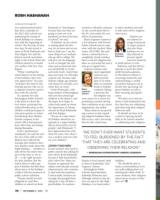
Embekka
Roberson
Maria
Lograsso-
Gaitens
“WE DON’T EVER WANT STUDENTS
TO FEEL BURDENED BY THE FACT
THAT THEY ARE CELEBRATING AND
OBSERVING THEIR RELIGION.”
— BIRMINGHAM SUPERINTENDENT EMBEKKA ROBERSON