

8 | AUGUST 26 • 2021
PURELY COMMENTARY
continued on page 10
continued from page 6
policy in Xinjiang — will face
new challenges. It is safe to
assume that the Taliban will
be wary, at least for a while,
about hosting global terror
networks such as al-Qaeda
— the cost to them in 2001
was too high and the lesson
has probably been learned.
But over time, Afghanistan
may yet again become a hub
of terror.
Meanwhile, at the symbolic
level — namely, the sense
that “the arc of history” now
bends toward Islamist victo-
ry — the imprint of the scenes from Kabul
may be devastating. The consequences for
regional stability could be severe, and vul-
nerable regimes may feel the need to cast
their lot with the winners, or even look to
Iran for shelter.
WHAT CAN THE U.S. DO?
This damage of the images emerging from
Kabul will not be easily undone; some of
the scars of Vietnam are still with us still.
The United States is implementing a large-
scale “exfiltration” plan for those marked by
service to U.S. forces in Afghanistan. Still,
the scope of the brutal acts that will follow
the Taliban’s victorious entry into Kabul is
painfully predictable. As former U.S. allies
are executed in a public way, and women
are relegated to servitude, the message to
the rest of the Muslim world, and beyond it,
could be quite dangerous. Has the West, and
specifically the United States, become what
the prophet Isaiah called “a broken reed”?
To counter this message as much as
possible, it is vital for the United States to
demonstrate — elsewhere since the Afghan
case is clearly beyond salvation — that it is
not a spent force. It would also be of deci-
sive significance to reassure traditional U.S.
allies, including Israel and other like-mind-
ed forces of stability in the region. This
would require not only proactive diplomacy
at the highest level but also actions that
would reassert the American commitment
to their security and survival.
Central to any such demonstration, given
what we witnessed in Afghanistan, would
be the way the United States (assisted by its
key allies, Britain and France) deals with
Iran’s defiant conduct. Provocations at sea;
rocket fire by proxy into Saudi Arabia and
Israel; regional subversion; and a rapidly
advancing military nuclear project — all
these require a robust response, not abject
surrender at the negotiating table in
Vienna.
True, the Afghan debacle (which
amounts to a resounding failure of the U.S.
“nation-building” concept) and the Iranian
challenge are different in nature and only
marginally related (there is some evidence
that Iran, despite the Taliban’s brutality
toward Afghan Shiites, was willing to help
them defeat the United States). But their
timing makes it even more important for
the United States to use this opportunity
to reverse the images of decline. Moreover,
European Union-style appeasement of the
murderous Iranian regime will not play
well with U.S. public opinion, come next
November. When necessary, the practice of
punitive actions against terrorism and sub-
version needs to be reestablished.
REGIONAL COHESION IS NEEDED
One of the keys to the survival of the
pro-Western forces in Southeast Asia after
the fall of Saigon in 1975 was their ability
to come together — despite deep historical
differences and grievances — in the form
of ASEAN. Created in 1967, it was given
its present form and functions only by the
TAC (Treaty of Amity and Cooperation)
in 1976. It was only during the mid-1990s,
after the Soviet collapse,
that the communist former
enemies, including Vietnam,
queued up to join it.
To some extent, and despite
the obvious differences, this
can serve as a general tem-
plate for those Middle East
nations who fear the conse-
quences of American retreat.
The Abraham Accords
already reflect, in many of
their overt and underlying
aspects, this need to “hang
together.
” What happened
recently in Tunisia can
be interpreted as a significant part of a
pre-emptive campaign to blunt the influ-
ence of Islamist political movements across
the region.
In addition to the highly proactive
United Arab Emirates (and the quietly
persuasive work of the king of Jordan),
it would be Saudi Arabia and Egypt that
would need to take the lead in organizing
the response; an opportune moment for
Riyadh to cross the threshold into open
relations with Israel — and to collect their
reward for it in Washington.
As for Egyptian President Abdul Fattah
el-Sisi, his powerful message to the schol-
ars of al-Azhar University on Jan. 1, 2015
(which they have yet to respond to in a
coherent way) remains the most lucid
clarion call against the scourge of Islamist
totalitarian radicalism which has swept
the Muslim world. His position should be
propagated and upheld by other like-mind-
ed nations (it is bound to be reviled and
rejected, however, by Erdoğan, Turkey and
its ally, Qatar). Recent steps by his regime
to back Sufi practices — abhorred by the
Islamist “purists”— point in the right direc-
tion.
As external but adjacent anchors of such
a regional response — given the doubts
about America’s role, which will not soon
fade even if the Biden administration does
take firm action — work should be done to
bring in both France and India. Both have
taken firm stands against Islamist radical-
ism, both have a vested interest in the out-
come, and both already have strong bilater-
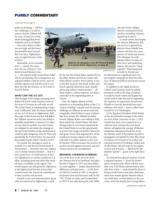
Afghanis run alongside a U.S. Air Force C-17 plane
as it departs Kabul, Afghanistan, on Aug. 16.
SCREENSHOT/JNS