

16 | AUGUST 26 • 2021
“One of the things that we know
about Holocaust education is that it’s not
just about teaching the history lesson,”
Bergman explains. “It’s for students to
understand that the Holocaust didn’t
simply happen, but that people made it
happen.”
In emphasizing the notion of choice,
Bergman says the museum aims to teach
youth that people have the ability to stand
up or speak out when they see hatred and
can be a “vehicle of change” in their com-
munity. “The Holocaust is a great example
of when that didn’t happen,” she says,
“and also when it did happen.”
EDUCATING ONLINE
In the age of COVID-19, when museum
access was temporarily limited due to
pandemic restrictions and shutdowns, the
Holocaust Memorial Center had to think
outside of the box to create accessible
ways for teachers and students to access
Holocaust education. Since the 2016 pass-
ing of the genocide mandate, a pivot to
virtual education was one of the biggest
changes.
In pre-pandemic times, the Holocaust
Memorial Center saw 35,000 students a
year walk through its doors to learn about
the genocide. To continue these field trips
in a COVID-safe manner, the museum
developed a Virtual Museum Experience,
or VME, that allows students and teachers
to learn about the Holocaust from the
safety or their homes or classroom.
Each VME session lasts 45 minutes
and is held over Zoom or Google Meet.
During the session, students watch
Holocaust survivor testimony videos,
view artwork created by survivors and
learn about different artifacts related to
the genocide. Since launching in January,
the Holocaust Memorial Center’s virtual
program has engaged more than 6,500
students statewide.
Additionally, lesson plans can be cus-
tomized with different themes that teach-
ers can choose from. These include pro-
paganda, choice and responsibility, resis-
tance, the Final Solution and more. After
a teacher expresses interest in scheduling
a VME, a Holocaust Memorial Center
educator reaches out to discuss learning
goals and how to tailor the session to that
classroom.
While the way students receive their
Holocaust education continues to change
in an increasingly digital world that is
now highly mindful of health and safety as
well, the core lessons stay the same. “The
lessons about individual responsibility and
dangers of silence will always be import-
ant,” Bergman explains. “What changes
sometimes is the delivery system.”
In the five years since the passing of
Michigan’s genocide education mandate,
the past year was arguably its most crucial
throughout a time of rising antisemitism.
“Whether someone is learning about
the Holocaust virtually or in-person, those
are all effective ways of having an impact-
ful experience,” Bergman says, “and taking
those lessons with them through their
lives.”
continued from page 15
OUR COMMUNITY
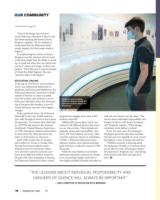
Students from Lansing
Christian School visited the
museum to learn about the
Holocaust.
“THE LESSONS ABOUT INDIVIDUAL RESPONSIBILITY AND
DANGERS OF SILENCE WILL ALWAYS BE IMPORTANT.”
— HMC’S DIRECTOR OF EDUCATION RUTH BERGMAN