
38 | AUGUST 12 • 2021
A
lmost 70 years after
Anne Frank: The
Diary of a Young Girl
was first published, The Diary
of Rywka Lipszyc appeared on
bookshelves to reveal the tragic
experiences of yet another teen-
ager descending into conditions
forced by the Holocaust.
While Anne Frank writes
about an Amsterdam family in
hiding together, Rywka (pro-
nounced Rivka) Lipszyc writes
about the separation of her
Polish family as she grapples
with the devastation experienced
during confinement in the Lodz
Ghetto before being moved into
the camps.
The information presented
in the Lipszyc journal, found
in Auschwitz and published by
San Francisco’s JFCS (Jewish
Family and Children’s Services)
Holocaust Center in partnership
with Lehrhaus Judaica, has been
supplemented through an exhi-
bition developed by the Galicia
Jewish Museum in
Krakow, Poland:
“The Girl in the
Diary: Searching
for Rywka from
the Lodz Ghetto.
”
Traveling the
United States,
the exhibition
will be on display through Dec.
30 at the Holocaust Memorial
Center (HMC) in Farmington
Hills, where visitors will view
translated text, commentaries,
associated artifacts and ghetto
photographs taken in secret and
including images of girls close in
age to Rywka.
To expand on the diary
contents and the ghetto envi-
ronment, there will be a talk
Wednesday, Sept. 1, by Derek
Hastings, Oakland University
associate professor of history.
LOVE OF JUDAISM
“The exhibit offers the per-
spective of an Orthodox girl
whose devotion to God and
faith is very visible throughout
the entire diary,
” said Jakub
Nowakowski, director of the
Galicia Jewish Museum and
exhibit curator working with a
team. “
Although Rywka lost her
siblings and parents, she still
said she was thankful for being
Jewish.
“The diary shows that the
longing of Rywka and many oth-
ers was for Palestine, for a new
home. There are lots we can take
out from her story in her writing
about
hunger, fear and hope. What’s
so helpful about her perspective
is that it’s about daily living and
the daily difficulties she faced.
”
Expert commentary explains
and contextualizes parts of
the diary. For instance, diary
sections about hunger and star-
vation are joined with descrip-
tions of ghetto conditions, food
rations and prohibitions against
holiday celebrations. Rabbis,
historians, psychologists, doc-
tors — all women — provide the
additional information.
“Rywka was Orthodox, and
her diary describes spending
time among girlfriends and
women,
” Nowakowski said.
“There are no men other than
her brothers and father in the
text. Because we wanted to
honor this very special environ-
ment, all the other voices in this
exhibition are from women.
“There are sensitivities in
her diary that are missing in
the texts created by men, who
are focusing on politics and the
situation. Entries coming from
men are more precise in terms
of numbers and information.
Rywka notes her feelings and
emotions, which are missing in
the diaries created by men.
”
LODZ GHETTO ARTIFACTS
Artifacts on display, assembled
from the Jewish Historical
Institute in Warsaw and the
United States Holocaust
Memorial Museum in
Washington, D.C., include per-
sonal items of those in the ghet-
to, such as children’s shoes made
in a Lodz workshop, as well as
newspapers and maps.
The traveling exhibit is sup-
plemented by materials supplied
by local Lodz Ghetto survivors.
An anonymous donor provided
German sewing needles used by
Jews making textiles and leather
goods for Germans in ghetto
workshops. A Polish family
photo album was donated by the
late Miriam Zack Garvil, who
resettled in Ann Arbor.
“We always try to bring a
Michigan element into our
ARTS&LIFE
EXHIBIT
HMC exhibit documents the
faith and fate of an Orthodox
girl from the Lodz Ghetto.
Anne Frank’s Polish
Counterpart
SUZANNE CHESSLER CONTRIBUTING WRITER
will be on display through Dec.
30 at the Holocaust Memorial
about
hunger, fear and hope. What’s
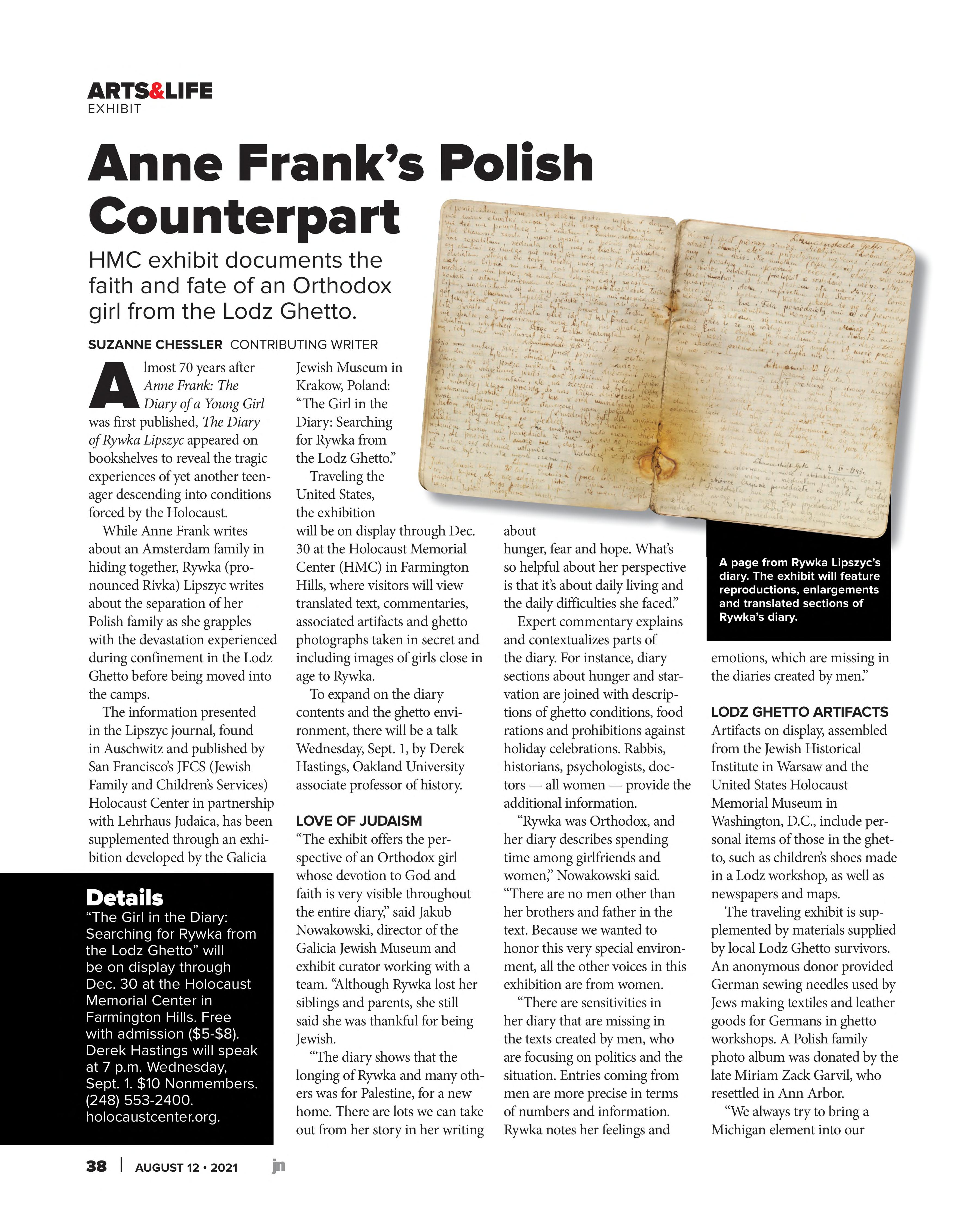
A page from Rywka Lipszyc’s
diary. The exhibit will feature
reproductions, enlargements
and translated sections of
Rywka’s diary.
Details
“The Girl in the Diary:
Searching for Rywka from
the Lodz Ghetto” will
be on display through
Dec. 30 at the Holocaust
Memorial Center in
Farmington Hills. Free
with admission ($5-$8).
Derek Hastings will speak
at 7 p.m. Wednesday,
Sept. 1. $10 Nonmembers.
(248) 553-2400.
holocaustcenter.org.