

AUGUST 12 • 2021 | 21
that directly benefit and sup-
port underserved community
members, such as those with
development disabilities,
autism or mental illness.
Deeper investments in areas
of clinical services and com-
pliance will allow for more
data-based decision making
and impact measurement, all
exponentially enhancing out-
comes for people served and
the community at large.
The merger will ensure
long-term sustainability of
vital services for individu-
als who need them, while
positioning the agency for
success in the everchanging
landscape of public mental
health service funding.
“This merger is vital
because it will strengthen
our operations, allow us
to provide more impactful
services and enable our new
organization to thrive for
many years to come,” said
Adelman. “By improving ser-
vices for the people we serve
today and ensuring the sus-
tainability of those services
for decades to come, we con-
tinue to realize our founders’
goals of meeting the needs
of vulnerable people in our
community.”
The two agencies offer
dozens of services, including
career counseling and job
placement for job seekers
with obstacles to employ-
ment, supportive housing for
individuals with severe men-
tal illness, financial educa-
tion, day programs for adults
living with developmental
disabilities and/or mental ill-
ness, counseling for families
in crisis, assistance and sup-
port coordination for adults
living with mental health
challenges, enrichment activ-
ities and more.
There are no plans for
reducing programs; in fact, it
is expected that the merger
will allow for programs to
be upgraded, updated and
strengthened.
registration fee includes
a ride T-shirt and drink
voucher.
Last year, the live ride had
to be canceled. There was no
official event, as Federation
simply encouraged people to
take part in their own ride
and to donate whatever they
wanted to the JCC Krakow if
they were able to do so.
Bracha Katz,
administrative assistant
at the Israel & Overseas
Department of Federation,
thinks people are excited to
get back to riding.
“A lot of them are big
bikers and they do this every
year, so it’s a good event for
riders to get out, get back
to normal and be able to
have some fun once again,
because it’s been a while for
a lot of people,” Katz said.
Katz hopes the ride can
bring some awareness to
the Jewish community in
Krakow as well as provide
fun for the riders.
“It’s not a sad ride. It’s a
lot of joy and hope, that’s
why it’s called ‘Ride for the
Living,’” Katz said referring
to the main Auschwitz to
Krakow ride and its local
counterpart. “It’s sort of
showing people, ‘yes, that
happened to us right here
and it was really sad — but
look at us, we’re a vibrant
community and we’re still
here, and we’re going to ride
our bikes from this place of
tragedy to the center of the
Jewish community.’
“It’s just a really beautiful
sentiment.”
Registration for the ride, which
costs $36, can be done at jlive.app/
events/523.
E
very family has a cher-
ished story, sometimes
many stories, but over
time, memories fade and some-
times storytellers are no longer
available. Rebecca Rosen’s
parents and grandparents were
doing genealogy research and
trying to figure out how to
document their family stories.
Her father, Marc Rosen,
Ph.D., a psychologist,
had taken notes from
conversations with his
in-laws, Janet Halper, 85,
about her life, and recorded
interviews with, Allen Halper,
87. The Halpers live in West
Bloomfield.
“Both are great storytellers,”
says Rebecca Rosen, 26, a
data scientist for a nonprofit
organization in New York City,
who has been living in Ann
Arbor. But written notes and
recorded conversations are not
a very accessible or permanent
record.
Then she thought of Kira
Appelman, a Detroit-based
artist. “Kira makes beautiful
books and is an incredible
artist and illustrator. She had
been working with storytelling
for a Jewish program and had
done some art books about
notable artists’ and writers’
lives,” Rosen said. So, she
commissioned Appelman to
create individual graphic books
depicting her grandparents’ life
stories.
The end result was a digital
novel about her grandfather,
a retired educator, who also
received a physical copy
of his digital book. Her
grandmother’s story was
translated into “more of an art
book.” Rosen said.
Since she had not told
them of her plans, they were
both surprised and delighted
to receive their books. “My
grandpa cried,” she says.
Custom graphic books document
grandparents’ stories.
Family Legacy
SHARI S. COHEN
CONTRIBUTING WRITER
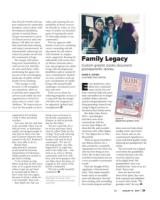
Cover of
Appelman’s graphic novel
Janet Halper,
Rebecca Rosen
and Allen Halper
grandparents’ stories.
Cover of
Appelman’s graphic novel