

S
en. Carl Levin was memorialized at
a heartfelt, privately attended service
at Ira Kaufman Chapel on July 30.
Rabbi Ariana Silverman of the Downtown
Synagogue and Rabbi Joseph Krakoff of the
Jewish Hospice and Chaplaincy Network offi-
ciated. Burial was at Clover Hill Park Cemetery.
A public celebration of Sen. Levin’s life will
likely be planned for the next month or two.
At the funeral, Carl Levin’s daughter Kate
Levin Markel spoke about her dad.
“He lived life to the fullest — his energy was
boundless,
” she said. “He was so smart, and he
used it to solve problems in the most creative
ways, big and small.
“Dad was blessed to be born into an
extraordinary family, to grow up in that fam-
ily, to be a part of that family and get incredi-
ble strength from that family.
”
Also at the funeral, Sen. Levin’s heartbroken
brother and lifelong best friend, Sander Levin,
spoke about him. “Carl’s book, Getting to the
Heart of the Matter, really expressed who he
was,
” Sander said. “‘Getting to the heart’ meant
getting to the essence of what it was all about.
“If you read his book, what he liked most
of all were the examples of where he stood
on the side of the downtrodden — the
dispossessed. And for those who ignored
it — those who thought the main riches in
life were their riches — he was willing to take
them on, but never with rancor.
“There could be no bigger heart [than
Carl’s]. So, that really led him into every effort.
“We grew up together for 85 years,
” Sander
said. “When we moved, the first thing our
parents did was to tear down a wall. And I
think their example got into Carl’s blood-
stream, and his life was tearing down walls.
“
And after that, we spent so much time
together, in all of our pursuits, and with all of
his determination and with all of his love.
“I think our lives together, if I might say
so, sends a kind of signal of what life is really
all about.
”
CARL
’S BEST FRIENDS
Rabbi Silverman noted that Sander, three years
older, and Carl were, in Sander’s words, insep-
arable. “They lived in the same room togeth-
er as kids and did everything with each other,
”
she said. “They played together, read the same
books, listened to classical music together, went
to camp together and snuck up to the balcony
of Shaarey Zedek during High Holiday services
together. In endless games of basketball in
the back yard, Sandy can’t remember a time
when he and Carl weren’t side by side.
“During Carl’s first year at Harvard Law
School, he and Sandy were able to live togeth-
er again.
”
The two brothers both served 36 years in
Congress. “
And in addition to their shared
pursuit of justice,
” Rabbi Silverman said, “they
also began their lifelong passion for playing
squash, which they continued into their 80s.
“Carl called Sandy his best lifelong
friend, because in 1960 he met his best friend,
Barbara,
” Rabbi Silverman said. “They were
set up on a blind date by Carl’s cousin Joe.
“They dated long-distance for a year. She
was in New York, he was in Detroit, and
they were married in 1961. Carl, a passionate
Detroiter would not move to New York, so
Barbara moved back to her hometown and
got a job in Detroit.
”
Within five years, they had three daughters.
“He adored being a dad,
” Rabbi Silverman
said. “Carl was a father who was full of ener-
gy, humor, love, playfulness and dedication.
“Carl was, and remained, Barbara’s greatest
fan. He adored listening to her play piano.
He made sure she was able to go to law
school at Wayne State and pursue her career.
”
A ZEST FOR LIFE
“In every way, Carl’s approach to life was so
pure and straightforward,
” Rabbi Krakoff
said. “It was motivated by the desire to serve
his fellow human beings — to make our state,
to make our country, to make our world a
better place than he found it. And he did this,
each and every day, well beyond measure.
“Carl was a man of deep sincerity and
authenticity — integrity and modesty. He
embodied a zest for life that was so clear in
everything he did.
“He maintained not one, but two standing
desks so he could pace back and forth, not
ever having to sit down while multitasking.
“During his four-and-a-half-year battle
with stage 4 lung cancer, he pushed himself
forward every day, as he did with everything
else in his life. Never for a moment losing his
fighting spirit,
” Rabbi Krakoff said.
“He did not complain, but only talked
about how blessed he was. And he did this in
each and every conversation until taking his
very last breath.
“May the values, the essence and the bril-
liant legacy of Sen. Carl Levin live eternally
in the souls of those who were so lucky to
know him and love him.
”
Loving Memories
of Carl Levin
18 | AUGUST 12 • 2021
THE PEOPLE’S ADVOCATE
SEN. CARL LEVIN
DAVID SACHS ASSOCIATE EDITOR
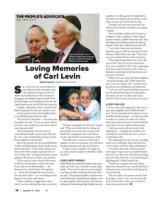
Barbara and Carl Levin
Carl and Sander Levin in
2010, as they were honored
by the Jewish Theological
Seminary of America