

10 | JULY 22 • 2021
PRO: CRT Helps Us
Teach Jewish History
A
nyone teaching the
past by skipping over
the unpleasant parts
isn’t teaching history. They are
engaged in propaganda.
Jewish tradition
understands
this: Refusing to
sugarcoat their
own people’s
culpability, the
sages themselves
teach that the
destruction of
the Temple by the Romans is a
consequence of baseless hatred
— among Jews.
Yet in nearly two dozen
states, the movement to
impose restrictions on the
teaching of history is gaining
momentum. Incited by a
national hysteria over Critical
Race Theory (CRT), advocates
of these educational fatwas
are borrowing a page from
authoritarian governments
like Vladimir Putin’s Russia
in a clumsy effort to avoid
discussing the messy,
controversial and painful
moments in America’s history.
And as a professional
historian, I can tell you that
these bans will be terrible for
anyone teaching or studying
Jewish history.
CRT DEFINED
What exactly is critical race
theory, and how is it apparently
— in the words of Florida Gov.
Ron DeSantis, a Republican
who is seen as a potential
presidential candidate —
teaching our kids “to hate each
other” and “hate our country”?
Critical Race Theory is a
body of ideas associated not
with the discipline of history
but with the practice of law.
Adherents believe that the
legacy of slavery is baked into
American society and culture
to such a degree that African
Americans continue to suffer
long-term, systemic economic
harm. It suggests that discussing
reparations should be on the
national agenda (hence the
PURELY COMMENTARY
CON: CRT Places Jews in
Discriminatory Boxes
W
hose job is it to
define who I am? Is
it an institution’s job
or is it mine?
In all the brouhaha over
critical race the-
ory (CRT), this
question is rarely
asked. That may
be because much
of the controver-
sy over CRT has
been about defin-
ing a nation and
a system.
CRT is a theoretical genre
within the larger realm of crit-
ical theory that has become
a mainstream movement. It
teaches that the United States
was founded on racism, oppres-
sion and white supremacy —
and that these forces are still
rooted in our society.
What gets overlooked within
this movement, however, is that
individual identities are being
erased. This shouldn’t surprise
us, given that a core idea of
CRT is that racism is not merely
the product of individual preju-
dice but something systemically
embedded in legal systems and
policies.
Whether one is white, black
or brown, individual identities
inevitably get submerged by
this systemic ethos. Further,
because CRT does not encour-
age dissenting views, individuals
feel pressured to go along with
whatever box CRT puts them
in.
This is highly problematic,
regardless of where one stands
on the overall issue. For one
thing, the imposition of indi-
vidual identity is a violation of
a fundamental human right —
the right to define ourselves as
we wish.
None of us have identities
that fit into neat boxes. I’m
a Sephardic Jew born in an
Arab Muslim country in North
Africa. Some people consider
me a Jew of color although I
look Caucasian. My identity
is also influenced by groups
to which I belong, from an
Orthodox synagogue to indus-
try groups to the passionate fan
base of the Los Angeles Lakers.
DON’T DEFINE ME
My political identity is of a cen-
trist who loves to engage with
all sides. My views can change
depending on new informa-
tion. It’s hard to pin me down
because I refuse to pin myself
down. All this to say that no
one has the right to define who
I am, either as a Jew or as an
individual.
And yet, in many ways, crit-
David Suissa
JNS
opinion
Should Jews Support
Critical Race Theory?
Henry
Abramson
JTA
MILWAUKEE TEACHERS’ EDUCATION ASSOCIATION/FLICKR
COMMONS/JTA
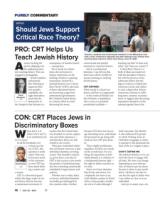
Teachers, students and school board members in the Milwaukee area
hold a news conference opposing new bills seeking to bar schools from
teaching ideas linked to critical race theory, June 12, 2021.