

68 | JUNE 24 • 2021
HEALTH
A
s COVID receded and patients
started to return in normal num-
bers to the Beaumont Ministrelli
Women’s Heart Center, Pamela Marcovitz,
M.D., a cardiologist and the center’s medical
director, began to observe the pandemic’s
impact on her patients.
From a cardiac perspective, she found
that some patients’ lifestyles improved
during the lockdown. They had more free
time and couldn’t eat in restaurants, so they
began cooking with healthy ingre-
dients, which had a positive impact
on their heart health.
“Restaurants tend to use a lot of
salt. By eating at home their blood
pressure was controlled better,
”
Marcovitz says. “Sometimes they
used the extra time to exercise
more. So, they had better choles-
terol levels and blood pressure.
Some lost weight — usually 5-10
pounds but one woman lost 38.
”
But other patients responded
differently — eating more restau-
rant carryouts and binge watching televi-
sion. These patients didn’t do as well, she
reports.
Sindhu Koshy, M.D., a cardiologist affil-
iated with Henry Ford Health System, says
that her female patients tended to fall into
bad health habits during the pandemic.
“They were not exercising and were
eating more junk food,
” she explains. “The
pandemic took a higher toll on women
because many had to supervise their chil-
dren doing virtual schoolwork, as well as
do their own work and handle household
chores. It took a toll on their mental health,
so they didn’t feel they could do as much
exercise.
”
POST-COVID HEART PATIENTS
Both Marcovitz and Koshy provided fol-
low-up care to their regular cardiac patients
after recovery from the virus, as well as new
patients who experienced first-time cardiac
symptoms after COVID.
“Many patients had complications
[after having the coronavirus] including
myocarditis, and some had reduced heart
function,
” Marcovitz says. “Some have pro-
longed symptoms of fatigue and shortness
of breath.
”
Koshy explains,
“
Anecdotally, there seem
to be more women expe-
riencing post-COVID
fatigue and shortness of
breath. Their brain fog
and fatigue seem to last
longer but most improve
within three months.
“The younger patients — under 60 —
tend to be the long haulers. Younger people
who hadn’t been vaccinated yet were more
likely to experience severe complications.
”
Sometimes it just takes time, Marcovitz
says. “We use exercise to build tolerance.
Patients need to hydrate while exercising
and their heart rate and blood pressure
must be monitored. Some people put off
routine checks of their blood pressure and
cholesterol because of the pandemic and
may need medical or other intervention for
coronary blockages.
”
In addition, some patients cut back on
cardiac rehabilitation out of concern for
COVID transmission or because these out-
patient programs were temporarily halted.
As an alternative to in-person rehabilitation,
some patients were given exercises to do at
home, including video instruction, she says.
Post-COVID patients have an increased
risk of developing clots in their legs and
lungs or having a stroke. This could be
because they were immobilized during their
bout with COVID, which can lead to clots,
Marcovitz says, or because their lifestyle or
work life became more sedentary during
the pandemic.
TREATING POTS
Both cardiologists have tested and treat-
ed for Postural Orthostatic Tachycardia
Syndrome (POTS) — a condition which
some patients developed after COVID.
POTS is a condition which affects blood
flow, causing rapid heart palpitations, faint-
ing and lightheadedness as well as chronic
fatigue and brain fog.
“POTS is a condition of the autonomic
nervous system, not primarily a cardiac
problem,
” Marcovitz says. “It can be very
debilitating and last a long time. POTS
affects mostly women between 13 and 50
years of age. We are seeing more of it in the
last year.
Any severe illness, surgery or extreme
weight loss can trigger it, she explains.
Symptoms can occur when individuals
stand up after sitting or reclining, or among
those who stand for a long time as part of
their jobs.
Treatments include core and leg exercis-
es, increased intake of fluids and greater
salt intake to lower adrenalin levels that
control heart rate. Compression stockings
or pantyhose can also help. She adds that
some medications, including beta blockers,
are available to treat it. “This is a common
reason why people are coming to us now,
”
notes Marcovitz.
Koshy has treated more cardiac patients
with POTS or POTS-like symptoms after
COVID as well. Many are severely dehy-
drated. “People who exercise are more likely
to notice it. COVID can affect any or every
system in the body,
” she says.
SHARI S. COHEN CONTRIBUTING WRITER
Some women deal with lingering
ef
ects on their heart.
After COVID
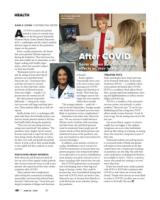
Dr. Pamela Marcovitz
with a patient
Dr. Sindhu
Koshy