

JUNE 17 • 2021 | 47
“I think they find it refreshing
that we’re doing something in a
unique way, about a subject that’s
been told over and over again,
”
Famie said. “I think they look
at it feeling hopeful, that maybe
we’re doing something that’s
going to reach an audience that
would not normally be reached
or care about it.
”
Realizing that Holocaust survi-
vors who are still alive are getting
up in age, Famie’s biggest goals
with the film are sharing their
experiences with the younger
generation and Holocaust edu-
cation. The other main goal is
wanting the younger generation
to know the value of their voices.
“I want them to understand
just how powerful and how
important their voice is, and how
important their future leadership
is in any capacity, and to never
take it for granted,
” Famie said.
“It’s this younger generation that
really has the impact to change
how we treat each other, how we
learn compassion and empathy
and understanding of one anoth-
er’s cultures and beliefs.
”
FIRST REACTIONS
When Famie needed an artist
and asked Callahan if she would
be interested in making a piece
for the documentary, Callahan
jumped at the opportunity.
“It’s been interesting for sure
because I’ve never done anything
like this,
” Callahan said. “It was
definitely interesting meeting
the survivors, I was speechless.
Learning their stories, going
through the museum and walk-
ing through seeing everything, it
was really heavy.
”
When Callahan first visited the
HMC, the first thing she saw was
the life-size train car in the lobby,
which inspired her to make the
piece.
“The glass butterflies [on the
train I created] are symbolic to
the lives that were lost but also
symbolic of resilience through
change,
” Callahan said. “They
all go through this awful tran-
sition after the Holocaust and
they somehow wake up every
morning, smile and continue on
with their life. The resilience and
strength they have is really what
inspired my piece.
”
Callahan said it took at least
100 hours, and possibly upwards
of 150 hours to make the train
car.
“I hope the younger generation
will see my piece, be curious, ask
questions, do their own research
and have an interest to learn
what happened,
” Callahan said.
“I hope the documentary as a
whole will make some impact
because we need to know and
remember what happened, honor
the lives lost and make sure it
doesn’t happen again.
”
Callahan took part in the
filming at survivor Fred Lessing’s
home, which ended up as a short
film called Bear and Fred that
Famie decided to enter into sev-
eral national film festivals to see
what would happen.
To date, the short film is a
recent selection to be featured
in the Big Apple Film Festival, a
finalist in the Independent Shorts
Awards (Los Angeles) and won
Best Documentary Short in the
Los Angeles Movie Awards.
The short film tells the story
of a teddy bear that accompa-
nied Lessing in his wanderings
from one hiding place to anoth-
er during World War II, and
became a symbol after being
loaned to Yad Vashem in 1996
as part of an exhibition called
“No Child’s Play.” The story is
also the subject of a children’s
book released in May 2020,
titled “Bear and Fred: A World
War II Story.”
Lessing’s hopes for the film as
a whole align with Famie’s hopes.
NEW GENERATION
“I would hope [Famie’s] goal is to
address and give this information
from Holocaust survivors to a
new generation,
” Lessing said.
“The actual survivors like myself
are getting very old and most of
them are dying off.
“I don’t know how it will be for
the young generation, but since
they’re listening to new genera-
tion people asking the questions
and getting the answers, maybe
it will work. I hope it will speak
to them.
”
While seeing antisemitism on
the rise across the board, Lessing
would like Holocaust education
to continue gaining steam.
“We need to understand what
happened in the past in order
to go into the future,” Lessing
said. “What’s encouraging is that
racism in this country is finally
being talked about and argued
about. It’s not just hidden as it
has been. If you don’t under-
stand and know what happened
in the past, it’s going to happen
again.”
Singer-songwriter Curtis Bates
has written two songs for the
film, one about what he learned
from the HMC tour called
“Stolen Dreams,
” and one con-
cept song that came about from a
conversation with one of the sur-
vivors involved in the film, Rene
Lichtman, called “Never Again.
”
Bates’ role in the film bridges
a mutual understanding of the
adversities experienced as an
American Black male with the
marginalized survivors, where
both experienced and continue
to experience racial and religious
discrimination.
“I do see similarities in the
adversities we face and they face,
”
Bates said. “Being discriminated
against due to things that should
be basic human rights like race
and religion, they’re definitely
similar.
”
Bates said he learned a lot
from spending time with
Lichtman, with the one thing
that stuck out to him most being
to “always question and challenge
authority.
”
Lichtman was immediately
attracted to participating in the
film as it went right along with
continued on page 48
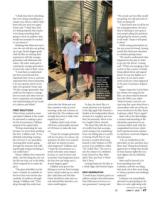
COURTESY OF KEITH FAMIE
Director Keith
Famie and
artist Hailey
Callahan, 23,
with her train
car proudly
in hand, pose
together at the
end of a night
of filming.