

JUNE 17 • 2021 | 45
COURTESY OF KEITH FAMIE
continued on page 46
that it does not happen again.
A documentary filmmaker
in Metro Detroit, Keith Famie,
is taking inspiring action to
boost that Holocaust educa-
tion. Since last July, Famie and
his Visionalist Entertainment
Productions team have been
in production on a PBS doc-
umentary film about the
Holocaust, starring the young-
er generation and directed
toward the younger generation.
Just weeks before COVID-19
was declared a pandemic in
the United States, Keith Famie
attended a speech by Holocaust
survivor Edith Maniker at the
Holocaust Memorial Center
(HMC) in Farmington Hills.
Maniker was giving the speech
to high school students.
Listening to Maniker’s
speech, Famie wondered to
himself if the speech really
stuck with the students.
“It wasn’t the messenger, she
was powerful and the story was
important,” Famie said. “But
she’s 80-something, and they’re
17, 19 years old. Did they really
get it? I thought there’s got to
be a better way, or a new way,
of telling the Holocaust story
that’s going to engage a young-
er generation, a non-Jewish
younger generation.”
The wheels were then set in
motion. Famie devised an idea
— finding peers of the younger
generation to tell the Holocaust
story, with those peers needing
to come into the project green
with very little knowledge of
the Holocaust, and not to be
Jewish. Another component
important to Famie was that
the peers would have a talent
of some sort, one they could
use to inspire others to tell the
story in some way.
“I wanted to find the right
individuals that I felt had the
sensitivity and empathy about
them already,” Famie said.
Famie spent a month-and-a-
half interviewing individuals,
before finding his two Shoah
Ambassadors: Hailey Callahan
of Rochester, a then 22-year-
old artist/sculpturist and grad-
uate from Detroit-based College
of Creative Studies (CCS), and
Curtis Bates, a singer-songwrit-
er from Detroit.
Callahan’s artistic medium
inspired her to recreate a train
car out of stained glass to tell
the story of how the trains
were used to transport Jews to
German death camps.
Bates’ musical medium
inspired him to write two rap
songs in the film which will
help illustrate general themes
of the Holocaust and, at the
same time, generate interest
with the younger generation.
FILMING BEGINS
Famie began filming by step-
ping into Callahan and Bates’
life, creating a backstory of
who they are and what they do.
Filming was done with Bates
in a studio and in the streets
of Detroit singing, and filming
was done with Callahan at CCS,
doing some creative sculpture.
An opportunity was also set
up for Callahan and Bates to
interview the five Holocaust
survivors who were chosen
with help from the HMC:
Maniker, Irene Miller, Mania
Salinger, Fred Lessing and
Rene Lichtman.
More filming was completed
with Callahan as she started
down the path of what she
wanted to create, and with
Bates as he started to work on
his songs.
Another couple of days were
spent filming at the HMC with
Professor Howard Lupovitch
from Wayne State University,
who specializes in Judaic histo-
ry, along with an extensive tour
of the museum with Callahan
and Bates talking about and
asking questions about the
Holocaust.
Filming was also done with
Callahan and Bates visiting
the homes of the Holocaust
survivors.
Filming for the unveiling
of Callahan’s train car took
place at the HMC on May 20.
Famie invited local cantors to
sing hymns and prayers during
the unveiling, along with a
violinist, to make it even more
special.
“Hailey chose to make
that,” Famie said. “I said to
Hailey, ‘You get inspired and
let’s just see where this takes
us,’ and that’s what she came
up with. I don’t think there’s
ever been anything like that
created in history, and it’s just
very powerful.”
Famie recognizes the filming
of the scene as the closing of
Callahan’s experience, and the
handing off of her experience
to her generation.
All of this filming took
place during the COVID-19
pandemic, which affected and
transformed the execution of
the filming in many ways.
“It was a curse and a bless-
ing, all in one,” Famie said.
“We had planned to film at
Auschwitz, and we were sup-
posed to travel to Poland, and
all of that stuff went in the
can. The whole project, pretty
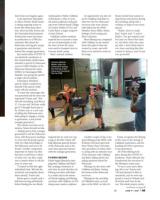
Violinist Nathan
Bieber plays his
instrument during
the filming of the
Holocaust memorial
film for PBS.