

38 | JUNE 10 • 2021
COURTESY OF ARI TOLWIN
dynamics of the industry were
too difficult,
” he says. “So, at
a certain point, with a friend
of mine, we had the idea for
Numilk.
”
BUILDING A BRAND
As an adult, Ari Tolwin followed
a primarily plant-based diet.
“When it comes to dairy-like
products, we’ve always sort of
bemoaned the fact that plant-
based milks just aren’t that
great,
” he explains. “They’re
filled with gums; they don’t have
a ton of nutrient value; and they
have the same antiquated supply
chain that produces dairy.
”
Tolwin started to brainstorm
how he could alleviate those
challenges and create a plant-
based milk that was healthy,
tasty and, above all, scalable to
grocery stores across the coun-
try. One feature he always loved
at Whole Foods was a peanut
butter grinder that allowed
shoppers to make fresh peanut
butter onsite. He wondered if the
same could be done for milk.
“We could make plant-based
milk that could be better for the
environment and more deli-
cious,
” Tolwin says of Numilk,
launched in 2018. “
And we could
do it in a way that was differ-
entiated [by in-store shopping]
to allow people to make fresh
plant-based milks on location.
”
Yet, in order to make almond
milk specifically, Tolwin would
need a special mill to process the
almonds. Because a mill is gen-
erally a large piece of equipment
that’s expensive to operate, his
goal was to create a mini-mill
that could easily sit within a
grocery store like Whole Foods.
Tolwin found a German com-
pany that made miniature mills
and enlisted its help as a vendor.
The first prototype for
Numilk’s mini-mill was created
and set for launch within a New
Jersey Whole Foods location.
But then things changed.
“We were about one or two
months out from completion of
the machine when Whole Foods
was purchased by Amazon,
”
Tolwin recalls. His Whole Foods
contact left the company, leaving
Tolwin and Numilk without any
connections.
Regardless, he decided to
complete the mini-mill and
managed to get it inside the
same local Whole Foods. “We
rushed the machine in the
store as quickly as we could,
” he
remembers. “We hoped to sell
100 bottles of Numilk a week.
On our first day, we sold 130
bottles.
”
A NEED TO PIVOT
It was clear that Numilk was a
hit. By Day 2, Tolwin saw 170
bottles being sold. In compari-
son, he says, Whole Foods gen-
erally sells 10 bottles of any juice
or milk product a week — mak-
ing Numilk’s sales a landslide
success. Yet over the next six
months, the mini-mill required
constant attention. Without
much testing, it was frequently
breaking down. By the time it
was fixed and ready for scaling
to other stores, the COVID-19
pandemic hit, and business came
to a halt.
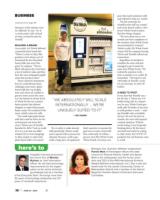
Ari Tolwin stands in front of the grocery story mini-mill.
“WE ABSOLUTELY WILL SCALE
INTERNATIONALLY ... WE’RE
UNIQUELY SUITED TO IT”
— ARI TOLWIN
here’s to
BUSINESS
continued from page 36
Michigan Gov. Gretchen Whitmer reappointed
Florine Mark of Farmington Hills to the state
Council on Physical Fitness, Health and Sports.
Mark is the ambassador and the former presi-
dent and CEO of the WW International (formerly
Weight Watchers International, Inc.). She is also the
board chair for the Jewish Community Center of
Metropolitan Detroit and a member of the Detroit
Regional Chamber Board of Directors Executive
Committee.
Forgotten Harvest announced
the recent hire of Michael
Butman as chief information
officer. He will lead technology
improvements for the organi-
zation as the senior technolo-
gy strategist and as a member
of the Executive Team. He brings more than
30 years of technology leadership and 22+
years of nonprofit experience.