

20 | JUNE 10 • 2021
H
e’s a kippah-wear-
ing Jew from Oak
Park and she’s a
hijab-wearing Muslim from
Dearborn — and the friend-
ship they have forged in the
U.S. Air Force has a lot to do
with religion.
Yosef (Yossie/Joe)
Hochheiser and Maysaa
Ouza are both captains in
the Judge Advocate General
(JAG) corps of the U.S. Air
Force. For Hochheiser, 38, it’s
a part-time gig as a member
of the Air Force Reserves.
But most of his workweek is
spent as a civilian domestic
violence magistrate judge in
Cuyahoga County, Ohio.
In 2016, Hochheiser was
doing his reserve duty at
Youngstown Air Reserve
Station in Ohio when he was
asked to research the issue of
providing a religious accom-
modation for a Muslim
recruit who wanted to wear
a hijab. Hochheiser himself
had received a religious
accommodation to wear a
kippah when he joined up.
Ouza, the daughter of
Lebanese immigrants, was
about to graduate from the
University of Toledo law
school when she applied to
be a JAG officer. She request-
ed a religious accommoda-
tion to wear the hijab, the
headscarf that many Muslim
women use to cover their
hair. The Air Force told her
she could request a religious
accommodation only after
going through officer train-
ing school, which she would
have to do without the hijab.
This she did not want to do.
Hochheiser worked on the
matter during one of his one-
week periods of Reserves
duty and submitted a report
that said more research was
needed on the issue. Then he
forgot about it.
Meanwhile, Ouza turned
to the American Civil
Liberties Union, which in
2015 had handled a case
involving a Sikh man who
needed an accommodation
to wear a turban in the
ROTC. A federal judge ruled
that the Army could not
deny him the accommoda-
tion.
When the ACLU pointed
out the similarity of Ouza’s
case, the Air Force reconsid-
ered and gave Ouza the reli-
gious accommodation before
she commissioned. They also
implemented a policy that
should help them avoid such
problems in the future.
SEEDS OF FRIENDSHIP
In 2018, Hochheiser was reas-
signed to the 88th Air Base
Wing at Wright-Patterson
Air Force Base in Dayton.
A few months later, he saw
a piece produced for NBC’s
Left Field about Muslims in
the military. It focused on an
active-duty Air Force JAG
officer whose request to wear
the hijab had led to a policy
change. He thought it must
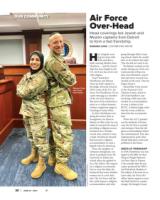
Head coverings led Jewish and
Muslim captains from Detroit
to form a fast friendship.
Air Force
Over-Head
BARBARA LEWIS CONTRIBUTING WRITER
OUR COMMUNITY
Maysaa Ouza
and Yosef
Hochheiser
COURTESY OF YOSEF HOCHHEISER