

32 | MAY 13 • 2021
M
ichigan-born
reporter and
editor Rebecca
Blumenstein is stepping into
a new role. After a long and
storied career in journal-
ism that has taken her from
Newsday to the Wall Street
Journal, Blumenstein, who
grew up in Essexville outside
of Bay City, is transitioning
into a top leadership position
as deputy editor in the pub-
lisher’s office at the New York
Times.
Blumenstein, 54, of
Maplewood, N.J., is a
University of Michigan alum-
na and previously served
as Michigan president of
Young Judaea, a peer-led
Zionist youth movement
with programs throughout
the U.S. Now, after four
years at the Times growing
their newsroom and cover-
age, Blumenstein is ready to
embark on a new chapter.
The Jewish News spoke to
her about the transition, her
goals in her new role and
building a career at the his-
toric publication.
Can you tell us about your
2017 transition to the Times?
My first job when I arrived
at the Times was to reinvigo-
rate and elevate our business
coverage. The Times had a
long tradition of great inves-
tigative business journalism,
but it was not enough of a
daily must-read. I hired Ellen
Pollock, the former editor
of Business Week, to be the
business editor, and we sig-
nificantly expanded our team,
particularly in Silicon Valley
and Washington. ‘Business’ is
now one of the biggest staffs
at the Times and because
of our traditional strength
in politics, we are uniquely
suited to cover the increasing
number of stories and issues
at the intersection of business
and politics.
From there, I took a role
managing the digital news
desk, which runs the website
and NYT app 24/7 around
the world. We saw historic
gains in readership as we
increased our news metab-
olism and launched more
live, continuously updated
briefings during major news
events.
During the relentless news
cycle of 2020, with the pan-
demic, the unrest following
the death of George Floyd
and the presidential election,
I headed a major expansion
of our live coverage. As a
deputy managing editor, I am
part of the masthead of the
Times and weigh in on other
issues facing the organiza-
tion.
I am also head of NYT’s
events, which have complete-
ly shifted to remote formats
during the pandemic, which
has allowed us to reach
bigger audiences than ever
before.
What are some memorable
stories your newsroom has
worked on during the past few
years that you’re particularly
proud of?
We have led the way in
writing about how technology
and the increasing influence
of the tech giants is reshaping
our world. From the sexual
harassment issues at Uber
under Travis Kalanick to the
spread of misinformation, the
Times is a leader in the highly
competitive coverage of tech-
nology.
During the election, we
developed a feature called
“Daily Distortions” that
debunked highly mislead-
ing and viral information.
Because of the Times’ author-
ity on search, our reporting
outranked that of the misin-
formation on issues like the
incorrect reports of prob-
lems with Dominion voting
machines.
I’m also proud of our
breaking news operation. We
are aiming to be the most
trustworthy destination for
breaking news, and with a
newsroom of 1,700 reporters
and editors around the world,
we can do more original
reporting in more places than
almost any other news orga-
nization.
I must add that a story that
is particularly memorable is
a rare one that I wrote — a
look at the changing politics
PHOTO CREDIT
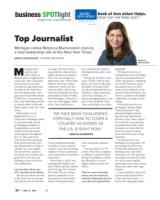
Michigan native Rebecca Blumenstein rises to
a new leadership role at the New York Times.
Top Journalist
ASHLEY ZLATOPOLSKY CONTRIBUTING WRITER
Rebecca
Blumenstein
“WE FACE MANY CHALLENGES,
ESPECIALLY HOW TO COVER A
COUNTRY AS DIVIDED AS
THE U.S. IS RIGHT NOW.”
— REBECCA BLUMENSTEIN
business SPOTlight
brought to you in partnership with
B I R M I N G H A M