

48 | APRIL 29 • 2021
HEALTH
I
t’s traditional therapy with a twist. By
combining cooking with talk therapy,
Culinary Art Therapy gives people a
chance to boost their wellness through a
fun and creative outlet.
Founded by West Bloomfield-based
therapist Julie Ohana, 42, Culinary Art
Therapy was an idea she developed
about 17 years ago while attending the
Wurzweiler School of Social Work at
Yeshiva University in New York City. She
wrote about the unique approach in her
master’s thesis, explaining how cooking
can be healing and cathartic in the thera-
peutic process.
“I remember knowing that this is
what I wanted to write about, and this
was something I very much believed in,”
Ohana explains. Shortly after graduating,
her friend helped her put together a web-
site using the information from her the-
sis. But then Ohana got married, had two
children and the idea was put on hold
while she focused on her family. Three
years ago, she decided to return to it.
“Now’s the time,” she recalls thinking.
Her kids were older, and she had more
space in her life to move forward with the
idea of Culinary Art Therapy. As a life-
long cook, it’s something she didn’t forget
about. “The time was right for me per-
sonally,” Ohana continues, “but the world
was ready for this idea.”
She explains that we’ve become a cul-
ture centered around food, where looking
at food on Instagram and Pinterest didn’t
exist at the time of her thesis. “I think
with the creation of these sites came an
awareness and a desire for people to be
able to consume this practice,” Ohana
adds. “There’s inspiration everywhere,
and inspiration is motivation but it’s also
connection.”
Through food, she aims to help peo-
ple make connections with one another,
themselves or the world around them.
“I work with a wide range of people on
a clinical basis and also people who are
looking to participate in an activity that
feels good, that brings people together,”
Ohana explains of her approach to ther-
apy. “They’re working on life skills and
different habits that are just good for
you.”
Each session is tailor-made to a client’s
needs and can be done individually or in
a group. Ohana starts with a question-
naire similar to an intake form that asks
people about their goals, intentions and
of course, the type of food they enjoy
most. She factors in allergies and other
dietary needs when developing a course
of action that combines cooking with
therapy.
“I ask people about their memories, the
foods they recall that they have a positive
Culinary Art Therapy
taps into cooking to
make connections.
Therapy
with a
Twist
ASHLEY ZLATOPOLSKY
CONTRIBUTING WRITER
continued on page 50
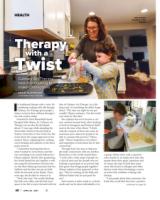
Julie and her
daughter in the
kitchen
COURTESY OF JULIE OHANA
COURTESY OF JULIE OHANA