

APRIL 29 • 2021 | 29
D
uring a May 10
Hadassah Greater
Detroit virtual pro-
gram, “Raiders of the Lost Ark:
The Hidden Jews of Ethiopia,”
Rabbi Josh Bennett of Temple
Israel in West Bloomfield
will explore the history of
Ethiopia’s Jewish community,
including the possibility that
the Ark of the Covenant may
be there, and also present a
video about the self-described
“Hidden Jews,” numbering
more than 150,000 in central
Ethiopia.
Bennett learned of these
Jews (called Beta Israel) after
Temple Israel member Suzi
Colman had a chance meeting
in 2018 with young Jewish
leaders at their synagogue in
Kechene, outside Addis Ababa.
She enlisted Bennett to help
fulfill her promise to help
them.
Bennett joined Colman and
a few others on a fact-finding
mission in November 2019.
They wanted to meet them, see
their religious practices and
learn how they could help.
After the trip, Colman,
Bennett and David Goldberg,
a global Jewish leader from
Cleveland, formed the Friends
of the Beta Israel of North
Shewa, with a nonprofit fund
under Temple Israel.
At the Hadassah meet-
ing, Bennett will talk about
efforts by the Friends group,
which include helping the
Kechene community set up a
modest mask-making oper-
ation during the pandemic.
Working with the Israeli NGO
CultivAid to coordinate its
efforts, another target is to
update agricultural methods.
Now, there is excitement about
two new opportunities.
“We are doing amazing work
because of a $50,000 Shalom
Corps grant,” Bennett said of
the global Jewish volunteering
initiative of the Israeli Ministry
of Diaspora Affairs.
“In the last six months,
Jewish Ethiopian volunteers
working with Israeli staff have
put new chimneys on two
pottery-making facilities to
make them safer. The projects
are designed to develop the
community and to upgrade
the economics of their crafts
programming and the facili-
ties in the gedams [the Jewish
religious centers, through the
Adopt-a-Gedam program].”
Bennett also is excited about
teaming with the World Union
for Progressive Judaism, the
arm of the Reform movement
outside the U.S., “to develop
partnerships to better support
the Ethiopians.”
Hadassah’s online program
begins at 11 a.m. May 10.
Register by May 6 at
hadassahmidwest.org/
GDraiders. Cost is $10. A link
will be sent May 9.
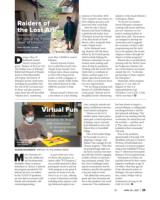
FRIENDS OF THE BETA ISRAEL OF NORTH SHEWA
Hadassah program
will look at the “hidden
Jews” of Ethiopia.
Raiders of
the Lost Ark
KERI GUTEN COHEN
CONTRIBUTING WRITER
A member of Beta Israel
M
etro Detroiters liv-
ing with intellectual
and developmental
disabilities whose in-person
attendance at Choices, a beloved
day program operated by JVS
Human Services, was halted
by the COVID-19 pandemic,
are now able to reconnect with
friends and community with
virtual programming.
As part of this new virtu-
al Choices day program, an
option called “JVS Frequency,
”
was recently launched to allow
participants to join in and out
of the program at any point. It
operates on Zoom every day
from 9 a.m. to 3 p.m., offering
a variety of interactive activities
including music, quizzes, cook-
ing, behavioral support exer-
cises, caring for animals and
plants, mindfulness exercises,
word searches and games.
“Choices on the Go” is
another option where partici-
pants gain a virtual experience
of taking a trip to a favorite
local destination such as the
Detroit Zoo or Greenfield
Village.
“One of the hardest things
for the people we serve is
adapting to change,
” said
Nathan Volz, manager for the
Choices program. “What they
are going through right now
has been a real loss: not meet-
ing with their friends, engaging
in daily activities or experienc-
ing community outings. They
face a lot of challenges under
typical circumstances, but the
isolation caused by the pandem-
ic has just made it worse.
”
Volz added that some partic-
ipants also have dementia and,
due to the pandemic, less social
connection. This combination
has been shown to impact a
person’s lifespan, so adding daily
enriching activities is vital for
their physical well-being. “The
people we are reaching want the
community, the interaction and
the activities — and they need
it. They want a chance to be
included in their community,
”
Volz said.
Prior to the pandemic,
approximately 120 people with
disabilities took part in Choices.
Of those, 20 individuals have
returned to in-person program-
ming at the Southfield JVS loca-
tion; 77 others have been partic-
ipating in Zoom programming.
Participants in Choices are
typically referred by their county
supports coordinator at age 26
(or older), when they age out
of the educational system in
Michigan. For more informa-
tion, contact Nathan Volz at
nvolz@
jvshumanservices.org or call
(248) 233-4335.
JVS of
ers online
activities for those
with intellectual
or developmental
disabilities.
Virtual Fun
ALISON SCHWARTZ SPECIAL TO THE JEWISH NEWS
Leslee Milgrom
does an arts and
craft activity.
JOHN HARDWICK