

8 | APRIL 22 • 2021
guest column
Judaism After the Pandemic
I
n countless conversations,
the same words arise to
describe this past year:
loss, loneliness, fear, as well
as opportunity, gratitude and
“silver linings.”
Mourners
grieved alone.
Parents suf-
fered exhaus-
tion. Children
regressed. Teens
and adults bat-
tled depression
and anxiety. Divorces multi-
plied.
Yet also, among the Jewish
community in particular,
adult education flourished;
the numbers of people par-
ticipating in prayer services
grew; and innovation took
hold. Synagogues adapted.
People reported renewed
focus on their most important
priorities, including family,
community and compassion
for those in need.
As COVID-19 transforms
from an acute crisis to a
chronic condition, Jewish
leaders are wrestling with
which institutional changes
brought about in the past year
deserve to continue. What
remains clear, however, is that
Judaism holds the potential
to address the greatest ills
facing humanity and, in a
post-pandemic world, partic-
ipating actively in synagogue
life offers the most direct path
to a life of meaning, purpose
and joy.
THE ROLE OF
TECHNOLOGY
Following the shutdown
of synagogue buildings,
the tools that create digital
gatherings revolutionized
notions of community. Zoom
and similar programs cre-
ated opportunities in which
Michigan synagogues might
grant aliyot to members win-
tering in Florida; for families
in mourning around the
world to join virtually with
their loved ones in reciting
Kaddish together; and for
those with illness or disability
to engage more fully in com-
munal life.
Synagogue members
reported connecting more
deeply with prayer services by
seeing their clergy up close
and by eliminating the dis-
traction of other worshippers
around them.
In a post-pandemic world,
synagogues and temples will
continue to utilize online tools
as a complement to in-person
adult education opportunities,
religious school and commit-
tee meetings. However, for
prayer in particular, syna-
gogues and temples will need
to decide the extent to which
they utilize technology. After
all, a fine line exists between
technology serving as an aid
to building community and
enhancing faith, and on the
other side, technology serving
as a distraction or impediment
to religious life.
WE NEED TO
BE TOGETHER
Indeed, suffering through the
pandemic for more than a
year emphasized for us that
technology cannot replace
real-life human companion-
ship; in-person community
is as vital to sustaining life
as food, water and shelter.
Rabbi Aaron
Starr
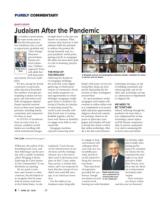
A Shabbat service at Congregation Shaarey Zedek, available for those
in person and on Zoom.
PURELY COMMENTARY
SCREENSHOT
Wilkerson, the author of the
bestselling book Caste, and
then following it up the next
day with a smaller workshop
called “Bringing it Home:
Exploring the Caste System
in Our Communities.” It was
absolutely eye opening.
We are quick to attri-
bute caste systems to other
countries, but she helped us
to recognize that the same
kind of system exists here
in the United States. As she
explained: “Caste focuses
on the infrastructure of our
divisions and the rankings,
whereas race is the metric
that’s used to determine one’s
place in that.” Caste, rather
than racism, is a better defi-
nition, and I was surprised to
learn that the concept of race
didn’t exist until 400 years
ago, as an American inven-
tion.
For the rabbis in my
breakout room, being able
to engage in deep
conversation with
colleagues about
caste and race was
incredibly pow-
erful, and all of
us left inspired to
bring the conversa-
tion home.
That same kind
of inspiration
pervaded the con-
ference, though
not always on such
a serious level.
Starting out with Havdalah
on Saturday night
and a totally enter-
taining perfor-
mance by comedian
Liz Glazer, the fun
continued the next
night as our chief
executive, Rabbi
Hara Person, invit-
ed us into her kitch-
en to demonstrate
her family seder
recipes.
Class reunions
are always a blast,
and this year we honored
THE CCAR continued from page 4
Rabbi Harold Loss
was celebrated for
marking 50 years
in the rabbinate.