

APRIL 15 • 2021 | 37
1995. “We thought of it as something that was aiming for the
universal values we had found in the Sholem Aleichem story
‘Tevye’s Daughters.
’
“Nevertheless, we knew in many ways it was a Jewish show.
We knew that it was a serious show, and we knew that it was a
long show. With all those things, we were worried that it might
not be accepted, and we were very nervous about the show’s
Detroit premiere.
“By the fourth week [with changes that included making
the play shorter], it was close to selling out, and we knew we
were OK.”
During the first year of operation,
famed Jewish composer and only-time
lyricist Richard Rodgers traveled to
Detroit, sat in the balcony at a small
piano and wrote songs and revisions for
No Strings as the cast, starring Richard
Kiley and Diahann Carroll, rehearsed
with full stage orchestra.
Broaching the subject of interracial
romance through dialogue and song,
No Strings became a trailblazing and
favorite show of Robert Nederlander
Sr., whose oldest brother, the late Harry
Nederlander, oversaw Detroit operations
and commented on the play and its suc-
cessful run.
“Richard Rodgers was a genius, and
Diahann Carroll was terrific,” Harry
Nederlander told the Detroit Jewish News
in 2001. “It was a show ahead of its time,
and the fact that it involved an interra-
cial romance never entered my mind
[when we were making our decision to
bring it here].”
London-based Sonia Friedman
Productions (SFP), associated with ATG
Productions, has developed and staged
more than 170 varied plays and brought a
Fiddler on the Roof run to London in 2019,
shortly before introducing Leopoldstadt to
the stage as Tom Stoppard’s play about a
Jewish family in Vienna.
SFP has won 55 Olivier Awards and 30
Tony Awards.
Alan Lichtenstein, 40-year executive
director for Nederlander programming
in Detroit and sometimes San Francisco,
worked with SFP in bring-
ing Mamma Mia! to the
United States for the first time and looks forward
to the opportunities the new associations can
bring to Motor City stages.
“SFP recently brought Harry Potter and the
Cursed Child to audiences so we hope to gain
some priority in bringing their imaginative
works to Detroit,” said Lichtenstein, who has previewed and
picked hundreds of shows for local audiences.
A NEW ERA
“The Broadway in Detroit family is excited about the new
arrangements, which include investments in theater technol-
ogy. There will be a lot of resources we can tap into for future
scheduling while working on the current season, which is in
flux because of the pandemic.
”
While firm dates are still to be established, the follow-
ing musicals should go ahead: Pretty Woman in November,
Hadestown in December and Hairspray in January. Finalized
dates will be posted at broadwayindetroit.com.
“We’re going to end up with six great
shows,
” said Lichtenstein, a member of
the Grosse Pointe Jewish Council and
fan of the one-woman narrative Golda,
which appeared twice at the Fisher, once
with Tovah Feldshuh and another time
with Valerie Harper.
“I just don’t know which ones they’re
going to be, but I expect to see one
Nederlander brother in the audience.
Joseph Nederlander, who is 94, remains
in the area and was the innovator of out-
door theaters starting with Pine Knob,
”
Lichtenstein said.
The Nederlander Company, now
with an administration that includes
third-generation family members
Robert Nederlander Jr. and James
Nederlander, will perpetually be tied to
the city through the family endowment
of the Apple Award, started in mem-
ory of David Nederlander’s wife, Sara
Applebaum Nederlander, known for
hosting Fisher stars and serving them
traditional Jewish dishes.
The award, presented annually to a
nationally recognized theater profession-
al, is accepted during a visit that features
a lecture presented to Wayne State
University theater students. Each win-
ner receives a crystal apple and $10,000
intended for a theatrical interest.
Past honorees include playwright Neil
Simon, composer Stephen Schwartz and
producer Jeffrey Seller, who grew up
in Oak Park, became enchanted with
the stage by watching Fisher Theatre
shows and went on to produce Rent
and Hamilton, which appeared locally
through Nederlander operations.
“Our Detroit staff has missed the excitement of the theater
during the time of pandemic closings,
” Lichtenstein said.
“
Although most staff members were able to continue with pay
during the time of the pandemic, we can’t wait for the shows to
return and hear the applause, which reminds me of the musical
Applause [written by Betty Comden and Adolph Green with
songs by Lee Adams and Charles Strouse] — another Fisher
Theatre world premiere.”
“WE ARE CONFIDENT
THAT THE ATG TEAM
WILL CONTINUE
TO LOOK AFTER
THE STRONG
FOUNDATION THAT
WE HAVE CREATED.”
— ROBERT NEDERLANDER SR.
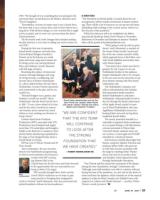
David Tobias Nederlander and his five
sons. Front row: Joseph, father David
and James “Jimmy.” Second row: Harry,
Robert and Frederick “Freddie.”
COURTESY OF FISHER THEATRE
Alan
Lichtenstein