

APRIL 8 • 2021 | 41
She was also drawn to the
humor behind the subject,
which includes clever takes on
whether the latke or haman-
tash is the more perfect Jewish
food. “It was funny,
” Krause
said. “I didn’t see a lot of funny
films at Jewish film festivals, so
the idea really intrigued me.
”
Krause began to research
the debate, which is academ-
ic in nature, and connected
with fellow debate enthusiast
Benjamin Lorch, who now
serves as an adviser and pro-
ducer for the documentary.
The two partnered on the idea
and officially began working
on the film in the summer of
2018 after Krause attended
the Jewish Cultural Festival in
Krakow.
Over the course of the next
two years, Krause flew all over
the world to gather informa-
tion. From Philadelphia to
Israel, she interviewed people
about the debate and what lies
at the heart of Jewish culture.
She spoke with rabbis, mod-
erators, foodies and debaters
— including the oldest living
debater, 98-year-old Bernie
Weisberger — about the leg-
acy of the “Latke-Hamantash
Debate.
”
Throughout her journey,
Krause also found herself
growing closer to Judaism,
a personal accomplishment
that she feels proud of. While
Krause personally sides with
the hamantash as the more
perfect Jewish food, she’s heard
sound debates on both ends in
favor of the winning dish.
FILMING CONTINUES
Though the pandemic has
slowed film production,
Krause continues to conduct
interviews over Zoom and
aims to complete filming at
the end of this year, along
with releasing the film soon
after.
She also filmed a trailer in
West Bloomfield in 2019 that
previews the documentary
and teases “the greatest Jewish
debate in history.
” It shows the
intense academic rigor behind
the subject, which has been
dissected from every view-
point imaginable.
Once the film is complete,
Krause plans to exhibit it at
Jewish film festivals and then
introduce it to the rest of the
world. “It’ll add a little light-
ness and remembrance of the
joy of our culture,
” she says of
Latke vs. Hamantash. “Not just
the struggles of our culture.
”
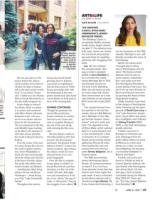
At the University
of Chicago with
Bernie Weisberger,
the oldest living
debater
Amy Krause,
center, and her
production crew
take a trip to
Krakow, Poland,
to see the
debate for the
first time.
THE WEDDING
COACH, SHIVA BABY,
HEMINGWAY’S JEWISH
MATADOR FRIEND
The Wedding Coach, a
six-episode Netflix romantic
reality series, began stream-
ing April 7. The advance pub-
licity says: Jamie Lee shares
her irreverent yet practical
tips and tricks for wedding
planning with struggling love-
birds.
Lee, 38, has climbed
the comedy ladder. She
was a writer’s assistant
(2010) to Jerry Seinfeld as
he co-hosted the reality
series Marriage Ref. In 2011,
she finished second on
the Last Comic Standing.
After, she did stand-up sets
on many major talk shows.
She’s best known as a core
cast member on the popular
MTV series Girl Code (2013-
15).
Two Jewish-themed mov-
ies opened in the last few
weeks. Donny’s Bar Mitzvah,
set in Michigan in the ’90s,
got terrible reviews “every-
where” and isn’t worth your
time. The opposite is true
of Shiva Baby, which opened
April 2 in some theaters and
is now streaming (for a fee)
on Amazon. It’s a comedy/
drama set at a family shivah
gathering. Almost all critics
have lauded the cast and
praised first time director/
writer Emma Seligman, 26, a
Toronto native.
The PBS documentary
series Hemingway (about
Ernest, of course) premiered
on April 5. It is a six-hour,
three-episode series that was
shown over three nights this
past week. It was co-directed
by Ken Burns (whose wife is
Jewish) and Lynn Novick, 58.
If you missed the first airing, it
can be streamed on the PBS
website. Michigan’s own Jeff
Daniels provides the voice of
Hemingway.
Before the series aired,
I thought about writing
about “Hemingway and the
Jews.” No literary scholar
disputes that he was, to
some degree, antisemitic.
But I was quite sure that
the Hemingway filmmakers
would address that issue. You
don’t win as many Emmys as
Burns and Novick have won
by ignoring the flaws of their
biographical subjects.
Oddly, however, I got back
to the subject of Hemingway
while checking out the back-
ground of David Caro Levy, a
“hot” Latin American Jewish
actor. Levy’s father was possi-
bly a bullfighter, and I flashed
on Sidney Franklin (1903-
1976), a Jew that Hemingway
greatly admired.
Franklin was born in
Brooklyn to Orthodox par-
ents. Estranged from his
police officer father, he went
to Mexico as a teen and,
almost on a dare, he stud-
ied bullfighting. He became
a successful bullfighter in
Mexico and Spain.
Franklin was funny and
fluent in Yiddish as well as
several Spanish dialects. He
was friends with Hemingway
and James Dean. He was
also gay, a fact he barely
concealed during his lifetime
(See 2019 NY Times arti-
cle, “The Gay Jewish Matador
from Brooklyn”).
CELEBRITY NEWS
NATE BLOOM COLUMNIST
ARTS&LIFE
IMDB
Jamie Lee