

APRIL 1 • 2021 | 15
an endless debate would soon
back down.
DETROIT ROOTS
But though he is a man of the
Senate, Carl Levin is, even more
so, a man whose roots are firmly
in Detroit.
The one incident he cites
at the very beginning of this
book, something that shaped
his career, happened when
he was Detroit City Council
president in 1975 and incompe-
tent administrators at the U.S.
Department of Housing and
Urban Development were refus-
ing to tear down blighted homes
they owned.
He led the Council to defy
HUD and tear down the homes
anyway, and dared HUD to sue,
saying, “Do you think even one
out of 12 jurors would vote to
convict?”
They didn’t sue. Levin said
HUD’s incompetence “convinced
me that our elected members
of Congress were not taking
responsibility for overseeing
the programs they had voted to
establish.
”
That helped lead him to the
Senate, where he rigorously tried
for a third of a century to hold
those responsible who ran, and
sometimes mismanaged, the
country he loved.
The voters clearly felt he did
something right.
They reelected
him the most
times in Michigan
— and longer
than all but 19
senators in the
history of the
country; one of
whom beat him
by a mere 13 days
is Joe Biden. (An
interesting bit of trivia: Levin is
also the longest-serving Jewish
senator in U.S. history.)
A few years ago, not long after
Levin announced he would not
be a candidate for a seventh term
in 2014, I asked him … why not?
True, he was going to be 80
that year, but many senators
serve well past that — and Levin
seemed more like a 60-year-old.
He was strong, intellectually vig-
orous and at the top of his game
as chair of the powerful Senate
Armed Services Committee.
Throughout Michigan, he was
widely respected, even loved.
Republicans had barely fielded
even token opposition in his
last two races; winning reelec-
tion one more time
would have been a
virtual certainty. So
why not run again?
Levin smiled.
Yes, he said, he
did feel great, phys-
ically and mentally
— “Now, yes. But I
don’t know how I
will feel at 86 [the
year his next term
would have ended]. Besides,
” he
added, “I want to spend more
time with Barbara and get back
to Michigan.
That was all true — and reflec-
tive of who Levin is. Few long-
time senators or congressmen
return to their home states after
their political careers; they stay
in Washington or retire to the
Sunbelt.
Not Levin; he and Barbara,
who will celebrate their 60th
wedding anniversary this year,
came back to where his political
career began, Detroit, where
he served two terms on City
Council half a century ago,
before his first campaign for the
Senate in 1978.
Leaving the Senate hasn’t
meant retirement; he joined the
Honigman law firm in Detroit
and helped establish the Levin
Center at Wayne State University
Law School, which is designed to
focus on, he said, “the essential
role that fact-based bipartisan
legislative oversight plays in our
nation’s constitutional system of
government with its emphasis on
checks and balances,
” which was,
in fact, perhaps the main focus of
Carl Levin’s career in the Senate.
His thought that nobody can
be too sure of their health after
80 turned out, sadly, to be all too
true; in 2017, Levin, a former
cigar smoker, was diagnosed
with lung cancer.
Fortunately, he was able to
fight it; today at age 86, although
his voice is raspy and no longer
as powerful, he says his health is
“stable.
”
DETAILS
Getting to the Heart
of the Matter: My 36
Years in the Senate.
By Carl Levin
338 pages; $29.99.
Wayne State
University Press,
2021
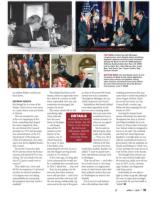
TOP ROW: Conferring with Michigan
congressman John Dingell before testifying
together. Signing ceremony with President
George W. Bush on the FY 2004 National
Defense Authorization Act, Nov. 24, 2003.
Left to right: Sen. John Warner, Sen. Levin,
Rep. Tom Davis, Sen. Susan Collins, Rep.
Duncan Hunter.
BOTTOM ROW: Carl and Sandy Levin at one
of dozens of State of the Union addresses
where they always sat together. Going
after Chinese counterfeit auto parts before
the U.S.-China Economic Security Review
Commission, June 7, 2006.
HS19604, CARL M. LEVIN PAPERS, BENTLEY HISTORICAL
LIBRARY, UNIVERSITY OF MICHIGAN
PHOTO BY JAY MALLIN/THE WASHINGTON
POST VIA GETTY IMAGES