

provide a tool that can be used by public
health officials.”
DWSD, GLWA and MSU have been at the
forefront of U.S. wastewater utilities using the
sewer system to help identify virus outbreaks.
“The expansion of the partnership gives us
targeted information that is critical in our
battle against COVID-19,” says Denise Fair, City
of Detroit Chief Public Health Officer. “The
expanded reach of this study allows us to
pinpoint neighborhoods and zip codes where
COVID-19 is trending upward, and we can use
this information to reach out to residents and
businesses in those areas to reinforce our
messaging with regard to testing, quarantine
protocols, contact tracing and even
assistance for businesses that need help in
developing a plan to operate while keeping
their employees safe during this pandemic.”
The approach that Xagoraraki and the team
are using is focused on community
MSU tests Detroit-area wastewater for early COVID-19 detection - continued from page 1
From its headquarters on Woodward Avenue
in Detroit’s Midtown neighborhood, MSU’s
Community Music School-Detroit has been
offering innovative music programming to
Detroiters of all ages since 2009.
Through its existence alone, the CMS-D has
helped to dismantle some of the economic
barriers that stand in the way of high-quality
music education. But a new program called
Music Empowers, launched by CMS-D in 2020
and funded by a grant from the Community
Foundation for Southeast Michigan, has
taken the school’s commitment to equity in
music education a step further.
Under the leadership of Juliet Hess, associate
professor of music education at MSU, Music
Empowers is providing the tools and training
to help all CMS-D faculty members build
social justice into their music curriculum.
A window and mirror
Historically, music curriculum has focused
almost exclusively on the musical styles and
achievements of only white American or
Western European men, and few have
bothered to ask whether any of it was
actually meaningful or relatable
to the students learning it.
Hess has experienced this
herself. “I know that when I
was a young child, I was
subject to a Christocentric
curriculum that didn’t
acknowledge my
Judaism,” she says.
“At that time, it
would have made
a significant
difference for me
to see myself
included in the
curriculum.”
Now, as an educator, she sees the issue
through the lens of the well-known relational
scholar Emily Style, who said that curriculum
should be “both a window and a mirror” for
students. Curriculum should both reflect
students’ realities back to them to affirm
them and also provide a window into the
realities of others.
To achieve that, Music Empowers calls for
something researchers have coined culturally
responsive teaching, which gives students
“opportunities to engage with music in ways
that are congruent with their own lived
cultural experiences with music.” In the
context of CMS-D, it will help music students
see a place for themselves in the world of
music, as both a form of self-expression and a
way of understanding others.
Social justice: not just a buzzword
So, what does “socially just” music curriculum
look—and sound—like? It’s flexible. It
incorporates the tastes and interests of the
students in the class, as well as musical
genres and practices that might be an
important part of their culture.
In some cases, that does include the music of
white American and Western European men.
But it might also include the music of various
PROGRAM SPOTLIGHT:
Music of the people, for the people, in Detroit
religious or cultural traditions: jazz,
Motown, R&B, hip-hop, drum circles or
mariachi, and in every lesson about every
genre, it acknowledges and makes space
for musicians and music aficionados of all
shapes, sizes, colors, genders and religions.
Hess envisions how this approach would
apply to the Jewish community.
“In thinking about the Jewish community…
it would mean that Jewish students would
see their experiences reflected in
classroom materials and activities, which
would also provide students outside the
Jewish community with an opportunity to
engage with the experiences of their
Jewish peers.”
And the same could be said for any student
who has previously felt “othered” by
curriculum. That’s what social justice is,
after all: the idea that no person should be
oppressed or cast aside by the system on
the basis of any aspect of their identity.
And while music, alone, isn’t going to fix
a world’s worth of social justice issues,
it is a great place to start teaching people
how to see and be seen, and to listen and
be heard.
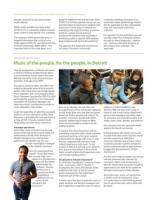
Music programming for parents and caregivers
with children under age six.
composite sampling and analysis. It is a
wastewater-based epidemiology method
directly applicable to urban metropolitan
areas with centralized wastewater
collection.
“Our approach has the potential to provide
warnings earlier than traditional systems
focused on clinical diagnostics—rapid or
not—which are inherently limited to an
after analysis of an outbreak,” says
Xagoraraki.
actually meaningful or relatable
to the students learning it.
Hess has experienced this
herself. “I know that when I
was a young child, I was
subject to a Christocentric
curriculum that didn’t
acknowledge my
Judaism,” she says.
“At that time, it
would have made
a significant
difference for me
to see myself
included in the
curriculum.”
Catch up on the latest from MSU
msutoday.msu.edu
Explore giving opportunities
givingto.msu.edu
More about alumni participation
alumni.msu.edu
Music programming for parents and caregivers
with children under age six.
Taylor Spurgeon-Hess (’21, Eli Broad College of
Business): “MSU doesn’t just have a Jewish community; it
has a Jewish community with character. MSU as a whole has
been a place that accepted all parts of me from day one.
‘Spartans Will’ is not just a slogan…it is a mindset shared by
the students and staff. The sense of togetherness and
camaraderie embodied by MSU’s community gave me room
to share who I was without fear of judgment. This fall, I felt
lost. My sense of community had been weakened when
classes went online. MSU Hillel took me in and gave me a
home away from home. The staff members and other
students brightened my day and proved that even a
pandemic can’t break the spirit of MSU.”
Sloane Krugel (’23, Lyman Briggs College): “There are
many Jewish students who attend Michigan State, so you
never feel alone. MSU Hillel has played a huge role in my
student experience—as soon as I arrived, they delivered a
welcome bag to my dorm room, and provided events for
Jewish students to meet each other and get to know the
Hillel staff. They host shabbat dinners every Friday so
students can have a “home-cooked meal,” and on top of all
of this, their building is open most days of the week so
students can have a quiet space to study. Especially now,
during COVID-19, Hillel has provided me and other students
with shabbat-to-go meals, Sunday brunches and many
other resources to help us succeed.”
Jordan Robinson (’22, College of Social Science): “MSU
allows students to be Jewish in a multitude of different
capacities, and the university’s administration and
undergraduate student government continuously work with
the Jewish Student Union to ensure that Jewish students
feel safe, welcome and included on campus. MSU Hillel,
specifically, goes out of their way to get to know you on an
individual level, support you on campus and help you get
what you want out of your MSU experience. Hillel allowed
me to get real world experience in my desired career
path—Jewish nonprofit work—and exposed me to people
and organizations that will strengthen me as both a person
and a Jew.”
LEARN MORE about MSU Hillel at msuhillel.org
Student perspectives on Jewish life at MSU - continued from page 1
MARK YOUR CALENDAR
MARCH 16, 2021 –
GIVE GREEN DAY:
Join Spartans from around
the world in showing support
for students at MSU on
Give Green Day! For more
information, watch our
social channels or visit
givingday.msu.edu
Catch up on the latest from MSU
msutoday.msu.edu
Explore giving opportunities
givingto.msu.edu
More about alumni participation
alumni.msu.edu