

FEBRUARY 18 • 2021 | 23
JOSEFIN DOLSTEN/
TIMES OF ISRAEL
Bari Weiss
also included a song lyric that
appeared to accuse the Jews
of manipulating the press, a
long-standing antisemitic ste-
reotype.
“We cannot support a
curriculum that erases the
American Jewish experience,
fails to discuss antisemitism,
reinforces negative stereo-
types about Jews, singles out
Israel for criticism, and would
institutionalize the teaching
of antisemitic stereotypes in
our public schools,” read a July
2019 letter from a coalition of
California Jewish state law-
makers.
Jewish organizations were
not the only ones to object to
exclusions in the first draft.
A letter signed by a coalition
of organizations representing
Middle Eastern immigrant
communities, spearheaded by
JIMENA, protested what they
saw as a lack of representation
in the curriculum.
A REVISED VERSION
Following the backlash to the
first draft, the state’s Education
Department said it recognized
changes were needed.
The following year, Gov.
Gavin Newsom vetoed a bill
that would have made ethnic
studies a high school gradu-
ation requirement, citing the
controversies over the draft as a
reason.
A number of Jewish groups
campaigned for the inclusion of
the Jewish experience in later
drafts. The latest curriculum
does include two lessons on
American Jews, including one
on the Mizrahi experience.
JIMENA drafted the lesson plan
on Mizrahi Jews last year.
Another lesson plan focus-
es on the complex nature of
American Jewish identity,
including the ways in which
some Jews experience “condi-
tional whiteness and privilege.
”
Both lesson plans discuss
antisemitism — including defi-
nitions of antisemitism from the
Anti-Defamation League as well
as the International Holocaust
Remembrance Alliance.
The sections echoing
anti-Jewish stereotypes and dis-
cussing the movement to boy-
cott Israel have been removed.
So have references to the Nakba.
Jewish groups that had cam-
paigned for the changes said
they were pleased with the latest
draft.
OBJECTIONS PERSIST
Some Jewish commentators
and activists still aren’t happy.
Even with the changes, they
say, the curriculum advances a
narrow ideology despite aiming
to increase tolerance and inclu-
sion.
Critics, including the former
New York Times
editor and writer
Bari Weiss, have
called for the phi-
losophy underpin-
ning it to be reject-
ed. Others agree.
“The Ethnic
Studies Model curriculum pro-
posed for K-12 California pub-
lic schools is divisive, encourag-
es victimization and promotes a
narrow political ideology,
” reads
the website of the Alliance for
Constructive Ethnic Studies, a
group mobilizing opposition
to the curriculum that was
co-founded by Elina Kaplan,
a Jewish activist who emi-
grated from the former Soviet
Union and is a self-identified
Democrat.
“The Ethnic Model Studies
Curriculum should be revised
to provide a balanced range of
perspectives, remove the polit-
ical agenda, and inspire mutual
respect and dignity.
”
In a January tweet criticizing
the curriculum, Weiss wrote,
“There is no more important
story in the Jewish world this
month.
”
Corresponding with the
Jewish Telegraphic Agency this
week, Weiss said her issue with
the curriculum is its embrace of
critical race theory (CRT).
“There are some people who
think CRT can be made kosher,
”
Weiss told JTA. “It cannot. It
is, at its root, hostile to Jews, to
liberalism and to American val-
ues. And it is the framework for
every single draft that has been
proposed.
”
Opponents of critical race
theory have generally come
from the right, and last year
President Donald Trump
instructed federal agencies
not to fund any program that
employs critical race theory or
anything that “suggests either
(1) that the United States is an
inherently racist or evil country
or (2) that any race or ethnicity
is inherently racist or evil.
”
In the case of the ethnic
studies curriculum, some of
its opponents are not Trump
supporters. Kaplan is a
Democrat and Weiss has been
vocally critical of Trump. The
members of the California
Legislative Jewish Caucus, who
objected to the initial draft and
praised the later ones, are all
Democrats.
REVISIONS ‘INSUFFICIENT’
The curriculum has gained
renewed attention of late,
including from liberal activists
like actor Josh Malina, due
to a critical article by Emily
Benedek in Tablet magazine,
which has published a number
of articles in recent years about
the perceived dangers of “woke”
thinking. The article features
the objections raised to the
first draft and notes that school
boards have been lobbied to
teach the original draft rather
than the revised one.
Benedek takes aim at critical
race theory, which she called
“dangerous” and “fundamental”
to the curriculum. She wrote
that the revisions celebrated by
Jewish groups are insufficient.
“The exclusion of Jews from
the original ESMC, which
was what the various organi-
zations spent their energies
on, was offensive,
” she wrote.
“But focusing on that is akin to
painting a house that is rotted
from the foundation.
”
An article about the curric-
ulum in the left-wing Jewish
Currents magazine also fea-
tured objections to the revised
version, but for the opposite
reason. The piece, by Gabi Kirk,
reports on the resignation of
the original draft’s authors, who
contended in an open letter that
the principles of ethnic studies
have been “compromised due to
political and media pressure.
”
In the article, Kirk wrote that
the latest draft of the curricu-
lum puts forward “a version of
ethnic studies unrecognizable to
scholars and community orga-
nizers engaged in the field —
and heavily influenced by those
who oppose the discipline’s very
existence.
”
The Education Department
is required to make a final
decision on the curriculum by
March 31.
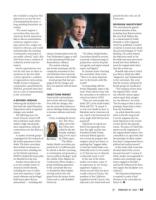
California Gov. Gavin Newsom
AGUSTIN PAULLIER/AFP VIA GETTY IMAGES/JTA