

FEBRUARY 4 • 2021 | 13
But he added, “It’s also great
to have other people around,
and my parents are endlessly
generous. We take turns cook-
ing, which is also interesting
because we all eat different
things. Valerie and I both
work California hours, so we
are often still working when
my parents have already eaten
dinner, but we are all together
on weekends, especially for
Shabbat meals. And Ariella
loves going to Zoom shul with
Grandpa, especially Havdalah.
”
As the time for Lisa Ellias’
children and granddaughter to
go back to California nears, she
is sad to see them go but is filled
with happiness that they could
be here.
“We are going to miss them
so much when they leave,
” she
said. “In the midst of so much
tragedy and disruption, we have
been given a real gift.
”
FAMILY DYNAMICS
At 23, Melissa Hall is among
those in the largest age-catego-
ry of young adults living with
their parents because of the
pandemic. That group includes
more than 26.6 million indi-
viduals, or 52% of Americans
aged 18-29, the most ever,
even higher than at the end of
the Great Depression, accord-
ing to a September 2020 Pew
Research Center report.
The report showed 23% of
them said the most important
reason was because their col-
lege campus had closed and
18% said it was due to job loss
or other financial reasons.
After living in Ann Arbor
for four years while she was an
undergraduate student at the
University of Michigan, Hall
stayed there and has worked
as a research coordinator in
Michigan Medicine’s psychiatry
department since May 2019.
Her decision to move back
to her mom, Janet Reinhart
Hall’s West Bloomfield home,
and her dad, Jeffrey Hall’s
Bloomfield Hills home, came
after realizing the difficulties
of working virtually from her
small apartment. “I felt that
through such an isolating time,
it would be nice to at least have
my family to lean on,” she said.
“I luckily have been able to
keep my current job. Although
some of my job tasks have
changed, I am thankful to still
be gaining great experience
and have the opportunity to do
new things there. And I recent-
ly had someone take over the
lease on my apartment, so that
is definitely a perk, to not have
to pay rent anymore in Ann
Arbor.”
Another bonus was getting
to see her older brother who
came from out of state to visit.
“He was able to return a few
times — safely — over the past
couple of months,” she said.
Hall said she and her parents
have created their own sys-
tem for being in shared space.
“There are definitely more
distractions being at home, but
overall, I think the logistics have
been working out well,
” she
said. “When I came back home
in March, I just became com-
fortable and got into a routine.
“
Also, I realized that many
of my friends were doing the
same. Although we couldn’t
hang out in the same capacity,
as summer rolled around, I felt
thankful to be able to see them
more often than if I were in
Ann Arbor. I plan on staying
here through the summer and
then hopefully go to graduate
school.
“I think I have grown closer
with my parents and our rela-
tionship definitely feels more
mature,” she said.
Her mom agrees. “It’s been
fantastic having Melissa
home,” she said. “The one
positive of COVID is that I’ve
been able to see my children
more often. It’s been an espe-
cially unique and fun time
working together from home.”
Being in the Detroit area
community again has had a
positive impact on Melissa. “It
feels nice to be able to appre-
ciate the places where I grew
up,” she said. “It also feels like
I’m a child again, living with
my parents, and with all of
my childhood friends back at
home.”
BETTER OFF NOT ALONE
Living in a group may have its
obstacles, with each individ-
ual, couple or family used to
their own schedule, privacy
continued on page 14
“I THINK I
HAVE GROWN
CLOSER WITH
MY PARENTS.”
— MELISSA HALL
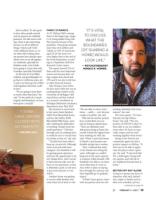
“IT’S VITAL
TO DISCUSS
WHAT THE
BOUNDARIES
[OF SHARING A
HOME] WOULD
LOOK LIKE.”
— PSYCHOTHERAPIST
RONALD E. HORMEL
Ronald E. Hormel