

DECEMBER 31 • 2020 | 9
letters
Dr. Peven and
Fertility Fraud
Oh my. The implications
are astronomical (Dec.
24, cover story). Brother/
sisters married. Children
affected.
All need to have their
DNA checked. Scary!
- Flora Miskin Castleman
Facebook comment
Drive-Up
Mourning
Our recent story on Ira
Kaufman Chapel introducing
drive-up greeting lines for
funerals (Dec. 10, pg. 25)
generated online discussion.
Why are they doing this
before the funeral service
begins rather than after?
According to Jewish
law one should not
attempt to comfort a
mourner until after
their loved one has been
buried. “Receiving lines”
before a funeral are
quite at odds with this
principle.
- Nancy Federman Kaplan
Facebook comment
I didn’t realize that
visiting prior to the burial
wasn’t the “norm” as I’ve
never been to a funeral
outside MI. I also learned
a few years ago about
the mitzvah of putting
a shovel of dirt on the
casket.
I have found that until
someone actually loses
someone close, there is a
lack of knowledge about
traditional practices when
someone dies. It’s almost
guest column
The RBG platter
R
uth Bader Ginsburg,
the longest-serving
Jewish associate jus-
tice of the Supreme Court
of the United States from
1993 until her death in
September 2020, is fondly
remembered for her ground-
breaking majority opinions,
advocacy for gender equali-
ty and women’s rights, gen-
der discrimination cases, and
for her passionate dissents in
numerous disputes.
She is revered by many
for making significant legal
advances for women, includ-
ing winning five gender
discrimination cases before
the Supreme Court between
1973 and 1976, and for
encouraging women to speak
up about their experiences
with sexual harassment.
RBG had a collection of
lace neckbands (jabots), or
collars, from around the
world. She often wore a jabot
when issuing her dissents
(black with gold embroidery
and faceted stones) as well
as another she wore when
issuing majority opinions
(crocheted yellow and cream
with crystals), which was a
gift from her law clerks. Her
favorite jabot (woven with
white beads) was from Cape
Town, South Africa.
When RBG died in
September, I thought of my
friend, Rebecca Leitman
Veidlinger, who I knew
would be affected tremen-
dously by her passing.
Rebecca, a Bloomfield Hills-
bred, Ann Arbor-based
lawyer, whose work focuses
on sex discrimination in
education, told me of her
deep admiration for RBG.
“While taking a feminist
jurisprudence class in grad-
uate school I learned about
RBG’
s advocacy and really
appreciated her way of doing
things. She had an incre-
mental, super-logical way
of addressing how sexism
harms women, and men,” she
said.
Rebecca has a huge respect
for RBG’s personal accom-
plishments, particularly how
she excelled in law school
while juggling additional
roles as mother and support-
ive wife. Rebecca confided
that she found many answers
in feminist theory to prob-
lematic issues that she herself
experienced and observed.
Josh Nathanson, co-owner
of Gallery and Goods, an
antique store in Pine Plains,
N.Y., designed a large, dark
ceramic platter, the color
simulating the Supreme
Court robe RBG wore, which
also features a replica of her
ivory-colored jabot, creating
a striking and memorable
dedication to the famed
jurist.
The auctioned proceeds
of this unique hand-made
piece of pottery was donated
to Willow Roots, a charitable
organization in Upstate New
York, dedicated to eliminat-
ing hunger, putting food on
the tables for those strug-
gling through the current
pandemic and beyond, elimi-
nating waste, and advocating
for healthy living.
Rebecca, through a series
of unique coincidences,
acquired the RBG platter on
Thanksgiving.
“I’m so grateful that I am
able to celebrate the life,
memory and triumphs of
RBG by displaying this won-
derful piece in my family
room,” Rebecca said.
Now she, her family, and
friends, can celebrate with
other RBG fans in her home
as she dedicates her career to
important social causes.
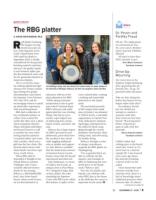
The Veidlinger family: Jeff, who directs the Frankel Center for Judaic Studies at
the University of Michigan; Rebecca; and their two daughters, Naomi and Mae.
DAVID NATHANSON
S. DAVID NATHANSON, M.D.
continued on page 10