

B
etween boredom from
spending so much
time at home and fear
of getting COVID-19, I, like
many Americans, have taken to
excessive online ordering. Not
socializing with
anyone except
my husband,
not being able
to see my family
or friends, not
eating in restau-
rants or shop-
ping in stores,
I have resorted
to COVID compulsive online
buying. (Could this be a new
syndrome?!)
While some of my purchases
have been practical, some are
things I never would have con-
sidered paying for in the past.
Last week, I ordered an electric
vegetable steamer. It arrived
with multiple parts — not only
will I never be able to assemble
or use it, I hate steamed vegeta-
bles! It seems I am not the only
one with a houseload of outra-
geous, impractical items getting
delivered to the door. Here
is what seven Michiganders
impulsively bought during
COVID:
Judy Federbush, psychol-
ogist, Ann Arbor: Indoor
humidity monitor. “It sounded
essential, but I can’t find any use
for it. What will I do with the
information? I haven’t looked at
it since I took it out of the box a
month ago!”
Karen Lindenberg,
retired professor, Ann Arbor:
Electronic egg cooker that
poaches eggs in triangular
shapes “Do I need it? No. Can
I boil an egg by myself? Of
course. When I begin entertain-
ing again for brunch, will my
guests request triangular eggs?
Highly doubtful!”
Emilie (EJ) Martin Palef,
who lives in New York City but
is from Detroit: A riding coat.
“I bought a riding coat from
Portugal. I had been eyeing it
online and when it went on sale,
I could not resist. Thankfully, it
didn’t fit because a riding coat
without a horse doesn’t work.
Had the coat fit, my next step
would have been looking online
for a horse!”
Lizzie Kompus, student
at Michigan State University,
Beverly Hills, Mich.: Adult
coloring books. “My room-
mates and I all bought coloring
books, Crayola markers and
colored pencils. It was a spur of
the moment purchase during
lockdown. We only used them
once and never picked them
up again — and I am not even
sure where I put mine!”
John Shultz, photographer,
Ann Arbor: Swimming hand
fins. “They looked really
glamourous in the photo.
They slip over your hands like
an amphibious, webbed hand.
Unfortunately, they were rath-
er useless in the water — $20
out the window!”
Linda Bennett, art museum
docent, Ann Arbor: Inverted
umbrella/cape to catch hair
during a haircut. “I thought it
would be a clever way to keep
my hair from falling every-
where during a home haircut.
Not only didn’t it fit around me,
but it also didn’t fit around my
5-year-old grandson. It might
have been better turned around
used as an umbrella!”
Fran Becket-Shell, busi-
ness owner, Royal Oak: Weird
humorous T-shirts. “I found
a website that sells unusual
T-shirts with sayings. Normally,
I would not have bought any,
but I wound up buying a bunch
for myself and my family. The
one for my husband reads,
‘Being a trophy husband is
exhausting.
’ Don’t know when
or if we will be wearing them in
public!”
8 | DECEMBER 24 • 2020
for openers
The Confessions of a
Lockdowned Shopper
Alice Burdick
Schweiger
Contributing
Writer
VIEWS
continued on page 11
Impulsive purchases produce only
buyer’s remorse during COVID.
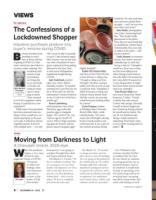
Alice’s
vegetable
steamer
ALICE BURDICK SCHWEIGER
essay
Moving from Darkness to Light
A Chanukah miracle, 2020-style.
W
hen the pandemic
began, a very close
friend of mine
suggested I keep a COVID-
19 journal
to reflect my
feelings, fears
and numerous
concerns as
to how, as the
leader of Yad
Ezra kosher
food pantry, I was going to
navigate through these dark
and unprecedented times.
On March 11, I wrote: “We
have to rethink everything! How
are we going to serve our client
families who depend on us? How
will we stay safe? If one of us
gets sick, our client families go
without food — that is not an
option. We have to completely
pivot from the status quo.
”
On March 12: “We decided
to change procedures and not
allow clients to enter the building.
We were going use the parking lot
for curbside pick-up. We worked
through traffic flow with police
department and figured out how
to organize the warehouse with a
small corps of volunteers and staff
to implement. Got notification
out to board, clients, website, and
volunteers of the new procedure.
”
Gov. Whitmer’s stay-
at-home mandate further
crystallized the fact that
for our clients to continue
receiving groceries, we, as
essential workers, had to
do whatever it would take
to keep us operating, even
if it meant long and nerve-
wracking days, not going
anywhere except home and
work, and relying on each
Lea Luger