

U
pon their permanent
arrival to Israel as this
summer ended, Mark
and Badonna Berkman, for-
merly of Oak Park, added a new
Hebrew word to their vocabu-
lary: bedood.
The coronavirus bedood,
or lockdown, was not the start
of an aliyah the Berkmans
may have chosen when they
discussed the idea of becom-
ing Israelis as far back as their
first dates while in their 20s.
The Modern Orthodox couple
spent the decades of their mar-
riage keeping the aliyah dream
alive while raising a family of
four children in an Oak Park
four-bedroom colonial.
Mark, 59, worked for 30
years as an assistant prosecut-
ing attorney for Genesee and
Oakland counties. The students
in Detroit’s Jewish day schools
knew Badonna, 63, for years as
a JARC School Inclusion special
needs teacher. Now that three
of their grown children are liv-
ing in Israel, the Berkmans in
2019 knew the time was right to
make aliyah a reality.
Studying in a Tzfat seminary
in the late 1970s and early ’80s
sparked Badonna’s yearning to
make aliyah. She remembered
sharing living quarters with
other young Detroit women,
including Chabad’s Jewish
Ferndale co-director, Chana
Finman.
“I have Aish HaTorah to
thank for instilling my love for
Jewish learning and a desire to
live in Israel,
” Badonna said.
“I’ve spent 40 years trying to get
back to living there for good.
”
Beyond the emotional and
spiritual pull of Israel, the
Berkmans knew they’
d have to
work out the practical logistics
such as supporting themselves
and acclimating to a new lan-
guage, smaller living quarters
and a hotter climate.
Making aliyah was a
10-month process that began
long before the pandemic.
The couple worked with the
nonprofit organization Nefesh
B’Nefesh to help with all the
logistics. When all arrange-
ments had been finalized,
the Oak Park house sold and
their most essential belongings
packed into a 20-foot shipping
container, it was time for the
Berkmans to say a departing
shalom to America and book
their one-way flight to Israel by
late summer.
The Berkmans adhered to
the strict guidelines set by
the Israeli Ministry of Health
before, during and after flying.
Unlike pre-pandemic Nefesh
B’Nefesh aliyah arrivals, there
were no large crowds at Ben
Gurion Airport to greet them.
But as the wheels touched down
in Israel, the Berkmans, along
with 60 olim, or immigrant,
families still clapped and shed
tears of joy.
“The first moments of aliyah
were not what we dreamed of,
but still, there were no dry eyes
on that plane when it landed,
”
Mark said.
LEARNING THE LANGUAGE
The pandemic continues to
unexpectedly shape these first
few months of being Israelis.
They hope to eventually work
in their professions, but for now,
they are getting to know their
mostly French olim neighbors,
keeping in touch with friends
and family over social media
apps, and taking on the biggest
cultural change — learning a
new language. While staying
put in their Ranana apart-
ment — found by their oldest
son Avraham, 32, before their
arrival — they take online ulpan
classes nine hours each week.
Fulfilling the dream to live
in Israel may be spiritually
moving, but there remains a
steep language barrier in nav-
igating life’s practicalities such
as buying a car, setting up bank
accounts, figuring out electric
bills and figuring out parking
space mobile apps. They are
ever grateful for their children
who are helping them in all
things Hebrew.
The Berkmans looked for-
ward to spending their first
High Holiday season with their
children and grandchildren. In
September, shortly after their
arrival and 14-day required
quarantine, there were joyous
outdoor reunions with their
three children and two grand-
children.
But just as the Jewish New
Year began, the Israeli govern-
ment enforced a mandatory
shutdown. There were no large
family meals in a sukkah or
travels around the country, but
since moving to Israel, they are
grateful for finally being near
their children and grandchil-
dren and the “little miracles”
that seem to happen daily. This
includes procuring schach — or
roof material for a sukkah —
from a group of religious men
who they randomly passed
while cutting down some
branches in the neighborhood.
“Where else in the world can
you have a conversation about
needing schach and a stranger
will know exactly what you
mean, even with a bit of a lan-
guage barrier,
” exclaimed Mark.
“Being in Israel, a Jewish person
no longer has to explain them-
selves. The familiarity of it all
makes you feel like you are sur-
rounded by one large extended
family.
”
Living in
Israel
COVID pandemic doesn’t stop Oak
Park natives from making aliyah.
STACY GITTLEMAN CONTRIBUTING WRITER
IN
THED
JEWS
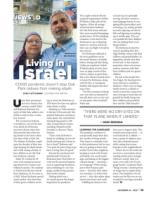
Badonna and
Mark Berkman
“THERE WERE NO DRY EYES ON
THAT PLANE WHEN IT LANDED.”
— MARK BERKMAN
DECEMBER 24 • 2020 | 13