

46 | DECEMBER 3 • 2020
R
abbi Lord Jonathan Sacks, Baron Sacks
of Aldgate, died Nov. 7, 2020, at age
72. Sacks was chief rabbi of the United
Kingdom, 1990-2013, the tenth rabbi to hold
that position. He was also a lord of the realm,
knighted by Queen Elizabeth in 2009.
The passing of Rabbi Sacks was noteworthy.
Condolences were offered by British Prime
Minister Boris Johnson and Israeli Prime
Minister Benjamin Netanyahu.
News media around the world
– Jewish and non-Jewish – car-
ried obituaries and personal
reminisces regarding Sacks. In
the Jewish Telegraphic Agency
obituary in the Nov. 12 issue of
the JN, former Prime Minister
of Great Britain Tony Blair
declared Sacks “
An Intellectual
Giant.”
As a highly visible chief rabbi, the
Cambridge-educated Sacks was a global voice
for Orthodox Judaism. He spoke clearly and
loudly against antisemitism, no matter its
origins, and decried anti-Zionism as a form
of antisemitism. Some of his positions on
women, marriage and rabbinical courts were
very controversial. In 2012, for example, Sacks
was criticized by prominent British Jews for
opposing civil marriage for gay couples.
Overall, Sacks generated more good reviews
than bad for his work. As he stated with a
bit of tongue-in-cheek: “There are many
great Jewish leaders. There are very few great
Jewish followers. So, leading the Jewish peo-
ple turns out to be very difficult.”
I wondered what I would find about Sacks
and other chief rabbis of England in the
William Davidson Digital Archive of Jewish
Detroit History.
The Chief Rabbinate of England was first
established in 1704. It initially emanated from
the Great Synagogue of London. Some histo-
rians find the roots of the concept of a chief
rabbi with Oliver Cromwell, who successfully
reopened England to Jews in 1656.
The chief rabbi developed as a secular,
non-governmental position, and eventually
extended its influence over the nations of the
British Commonwealth. The position is also
a global bully pulpit for Judaism. Sacks was,
perhaps, the most influential chief rabbi in
history.
The Archive holds a few interesting
reports about the chief
rabbi. The first mention of a
chief rabbi was in the Sept.
23, 1921, issue of the Detroit
Jewish Chronicle, that cited
Rabbi Joseph H. Hertz. The
chief rabbi had arrived in
London after raising 60,000
pounds for a Jewish War
Memorial Fund. The only visit
of a chief rabbit to Detroit was
noted in the Nov. 11, 1969, JN
when Sacks’ immediate prede-
cessor, Immanuel Jakobovits,
visited Congregation Shaarey
Zedek.
Sacks was introduced to JN
readers as chief rabbi in the
Jun. 1, 1990 issue: “British Jews’
New Chief Rabbi Not From The
Traditional Mold.”
Sacks was a prolific and influential writer.
Many references in the JN related to dis-
cussions of his work such as a “Lunch and
Learn” about his book “Not In God’s Name:
Confronting Religious Violence” at Adat
Shalom on Sep 27, 2016, or a video lecture by
Sacks on Oct 11, 2017, at Congregation Beth
Ahm.
Perhaps the most fit-
ting tribute to Chief Rabbi
Sacks was the High Holiday
greeting from the Jewish
Federation of Metro Detroit
for 2018 that used his
words: “I don’t need you to
agree with me; I need you
to care about me.”
Want to learn more? Go to the
DJN Foundation archives, avail-
able for free at www.djnfounda-
tion.org.
Looking Back
Remembering Rabbi Sacks
The Archive holds a few interesting
Memorial Fund. The only visit
of a chief rabbit to Detroit was
JN
when Sacks’ immediate prede-
visited Congregation Shaarey
JN
Jun. 1, 1990 issue: “British Jews’
New Chief Rabbi Not From The
Sacks was a prolific and influential writer.
Mike Smith
Alene and
Graham Landau
Archivist Chair
extended its influence over the nations of the
British Commonwealth. The position is also
a global bully pulpit for Judaism. Sacks was,
Remembering Rabbi Sacks
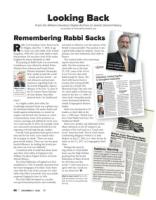
Jonathan Sacks,
former chief rabbi of the
United Kingdom, in 2000.
JOHN DOWNING/GETTY IMAGES VIA JTA
From the William Davidson Digital Archive of Jewish Detroit History
accessible at www.djnfoundation.org