

16 | NOVEMBER 26 • 2020
town to attend college at the
University of Michigan. Like so
many Iron Mountain teens, he
did not move back. His mother
was the last family member
there, and she left in 1990 fol-
lowing Kushner’
s father’
s death.
The last time Kushner saw
the inside of his former syn-
agogue was seven years ago
when he attended a family
reunion with about 40 rela-
tives. Many of those in atten-
dance were descendants of
Sam Rusky, a peddler and one
of the first Jewish settlers in
Iron Mountain. He was also
Kushner’
s great-grandfather.
At one point during the fam-
ily gathering, Kushner and his
relatives gathered inside their
former synagogue, a simple
white rectangular building that
sits unassumingly on a neigh-
borhood street corner. They
spent the time reminiscing and
rediscovering familial dedica-
tion plaques and other artifacts
which flooded their conver-
sations with an abundance of
memories.
Aside from the Star of David
located above the front door,
it would be easy to ignore the
100-plus-year-old congregation.
The simple white rectangular
building, which looks more like
a house than a place of worship,
had a history of members pon-
dering its long-term viability.
As far back as the late 1930s,
the Jewish population began to
decline and congregants won-
dered what the future would
bring.
In the 1940s, membership
consisted of approximately 20
devoted families. At that time,
services only occurred during
the High Holidays, if there
was a yahrtzeit or on the rare
occasion of a bar mitzvah. A
full-time rabbi was no longer
necessary. Men and women
were now sitting together, and
the balcony, once reserved for
women, converted into a stor-
age room. Esahe mikvah had
been removed.
In the 1950s, while there were
still enough men for a minyan,
it was sometimes an effort to
assemble one. Although Anshe
Knesseth Israel was never affili-
ated with a movement, services
became Reform in the 1970s so
women could be counted in the
requisite prayer quorum.
High Holiday services were
almost entirely in Hebrew, and
“incomprehensible,
” according
to Jim Zacks, a retired professor,
now living in Okemos. They
occurred under the leadership
of a visiting rabbi or someone
knowledgeable enough to lead
the congregation in prayer.
Zacks lived in Iron Mountain
for 18 years, from the time he
was born in 1941 until 1959
when he left to attend Harvard
University. Despite going to
services he didn’
t understand,
Zacks has fond memories of
Sunday school plays, holiday
celebrations and his bar mitz-
vah. He recalls with particular
fondness being in Sunday
school and learning about the
creation of the State of Israel.
“My childhood experiences
in the congregation; it was a
warm feeling. It felt like some-
thing special was going on.
Even when I was too young
to understand what it was all
about,
” said Zacks.
COMMON ANCESTOR
When describing her memo-
ries, Susan Cohodes expressed
similar sentiments about
the synagogue and its recent
sale. Cohodes, 59, is the third
generation of her family who
lived in Iron Mountain, start-
ing with her grandfather, a
Lithuanian peddler who settled
there around the late 1890s. At
the time she lived there, her
family comprised the major-
ity of Jewish residents. Only
three families in the congre-
gation were not related to the
Cohodes.
“
At first, I was saddened by
the news, but then I thought
I’
m not moving back there,
and there’
s no longer a Jewish
community,
” said Cohodes. She
was glad to learn the building
would be put to good use by a
nonprofit organization that runs
12-step programs and that syn-
agogue artifacts, including the
Torah, are being used in other
congregations.
“IT’S SAD TO SEE YOUR CHILDHOOD SYNAGOGUE
CLOSE, BUT WE KNEW IT WAS GOING TO HAPPEN.”
— WENDY RUSSMAN-HALPERIN
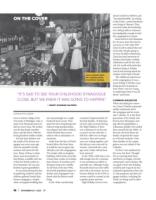
Susan Cohodes’ father
Ben Cohodes and her
Uncle Morris Cohodes.
continued from page14
ON THE COVER