

10 | NOVEMBER 12 • 2020
VIEWS
young voices on Israel
I
n June, a group of young
women from Huntington
Woods organized a commu-
nity march as a part of the glob-
al Black Lives Matter uprising.
The core organizing team
had several Jewish women —
including me, Rebecca Driker-
Ohren — as well as some
Palestinian friends from the
neighborhood.
Together we led hundreds
of people from our city in a
powerful demonstration, loudly
condemning police brutality,
white supremacy and right-
wing nationalism.
Chanting “Black lives matter”
alongside the folks who raised
us made us feel proud of our
little suburb. It was inspiring
to see our friends and families
standing up for justice, free-
dom, and equality. But, honest-
ly, we haven’
t always felt proud
of the political stances that
our communities have taken,
specifically the ways in which
the local Jewish establishment
has supported endless military
occupation in Israel/Palestine.
We were left wondering
whether renewed Jewish enthu-
siasm for Black civil rights
would extend to the rights of
Palestinians.
ANNEXATION
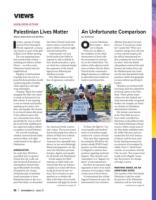
Six weeks later, IfNotNow
assembled anti-occupation
Detroit Jews for a rally out-
side the Jewish Federation of
Metropolitan Detroit build-
ing in Bloomfield Township.
Prompted by the Trump-
Netanyahu plan to formalize
Israeli annexation of more
Palestinian lands on the occu-
pied West Bank, we demanded
that Metro Detroit Jewish insti-
tutions refuse to fund this fla-
grant violation of human rights
and international law.
Unfortunately, our local
Jewish leaders have failed to
respond to calls to defund de
facto Israeli annexation, a proj-
ect which has continued despite
the suspension of the formal
legal process following the
Abraham Accords.
This official silence in the
face of oppression contradicts
the American Jewish commu-
nity’
s values. The recent actions
that Jewish people have taken in
defense of Black lives embody
these values. As surveys of
American Jews repeatedly have
shown, we are overwhelmingly
liberal and progressive. So why
won’
t the Federation promote
freedom, dignity, and equality
for all Israelis and Palestinians?
Jewish support for BLM
expresses a widely-held com-
munal belief that our Judaism
compels us to stand with those
facing the brunt of state vio-
lence. But it remains an open
question as to whether the
elites at the helm of our Jewish
institutions will apply the Jewish
Rebecca Driker-Ohren and Zak Witus
Zac Schildcrout
Palestinian Lives Matter
An Unfortunate Comparison
O
f course Palestinian
lives matter — that is
not in dispute.
What one can dipute is
the conflation of one-sided
denunciation of Israel with
the movement for racial jus-
tice in the United States. The
authors of the adjacent article
seem to believe that the Metro
Detroit Jewish community’
s
alleged reluctance to sufficient-
ly admonish Israel renders its
leaders moral hypocrites.
To them, the fight for “uni-
versal equality and freedom”
seems to necessitate myopic,
context-free censure of Israel.
They open their arguments
by touting the IfNotNow-led
protest outside JFMD’
s head-
quarters, as if the institution
is obligated to endorse their
positions regarding territorial
disputes. They describe such
“annexation” as a “flagrant vio-
lation” of international law.
But there are persuasive legal
arguments in favor of an Israeli
extension of sovereignty within
certain areas of the territory.
As international law scholar
Eugene Kontorovich notes, the
International Court of Justice-
affirmed principal of uti possi-
detis juris (“you possess under
law”) posits that “When new
countries emerge from old ones
or from colonial empires, the
last official international bor-
ders constitute the new bound-
ary lines.
” After the British
relinquished control of the land
between the Jordan River and
the Mediterranean Sea, Israel
was the state that declared inde-
pendence within that geograph-
ical area without specifying its
borders.
Therefore, per Kontorovich’
s
reasoning, Israel has substantive
territorial claims in the West
Bank. There’
s plenty of pre-
cedence for this: Jordan’
s and
Iraq’
s internationally recognized
borders, for example, are based
on colonial-era Mandatory
administrative divisions.
The territory now known
as the West Bank has never
been wholly controlled by a
Palestinian Arab political entity.
The limited Palestinian self-gov-
ernance within certain areas of
the West Bank established after
the 1990s Oslo peace process
marked the first such instance
in history, and the areas eyed
by the Israeli government for
an extension of sovereignty lie
within “
Area C”
, which Israel
controls, in accordance with the
Oslo Accords. That means Israel
would not be illegally “annex-
ing” the territory of a foreign
sovereign country.
PAINTING ISRAEL AS AN
APARTHEID STATE
The majority of the West Bank’
s
Palestinian Arabs live under
the purview of the Palestinian
Authority, and the Gaza Strip
continued on page 12
continued on page 12
ALEXANDER CLEGG/JEWISH NEWS
In July, about two dozen
protesters gathered in
Bloomfield Township in
response to the impend-
ing Israeli annexation of
the West Bank.