

32 | NOVEMBER 5 • 2020
‘Never
Normal’
SUZANNE CHESSLER
CONTRIBUTING WRITER
ARTS&LIFE
ART
Miasma
Mirror,
2020
J
acob Saphier and Ian Klipa reacted to
the pandemic in the way they usually
react to a known environment. They
designed and fabricated a related three-di-
mensional piece for an interior space.
The Wasserman Projects in Detroit
reacted to the piece in the way gallery
administrators usually react to admired
works, even during a pandemic. They put
it on display.
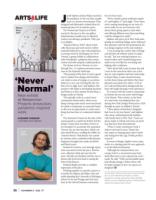
“Miasma Mirror, 2020,
” which artisti-
cally showcases past and current crafted
materials believed to cope with pandemics,
is among works by 20 designers in Never
Normal, a group exhibit in collaboration
with Form&Seek, a platform that creates,
curates and sells uniquely crafted products.
The theme of Never Normal, on view
through Dec. 12, explores personal connec-
tions to the domestic landscape.
“The prompt of the show is such a good
way to explore how design and furniture
can create a sense of change or accommo-
dation to a new way of living like the one
that we’
re in right now,
” said Saphier, who
partners with Klipa in developing furniture
and fixtures as they operate Donut Shop, a
design studio in Detroit.
“We typically work in a much more
commission-based realm, where every-
thing is being made much more functional
for retail or restaurants or someone’
s home
so this was an opportunity to create some-
thing that had more of a statement behind
it.
”
The statement is based on the idea of the
sneeze guard as a quick-fix divider, but the
artistic version does not allow viewers to
see through it to accentuate the separation.
Viewers can see into the piece, which con-
tains dried flowers, recalling the 1800s-era
“miasma theory” that disease was caused
by noxious odors combatted with pleasant
fragrances brought into masks by herbal
and floral scents.
Instead of a mirror, a see-through epoxy
resin was used to form the piece. Flowers
were collected, dried and cast into the
resin. All sides are finished, and the way to
discern the front from back is seeing the
front of the flowers.
Pedestal display provides a complete
impression of the piece.
Working together on specific projects is
everyday for Saphier and Klipa, who met
while attending the University of Michigan
School of Art and Design and who have
been in the Detroit business community
for over four years.
“We’
ve created a good symbiosis togeth-
er,
” said Saphier, 27 and single. “Even when
we’
re creating something on our own, it’
s
never really on our own because we’
re
always there giving input to each other
and offering different ways that something
could be designed or made.
”
Saphier, who grew up in New York antic-
ipating an industrial design career, followed
that intention with his first professional job
as a design engineer in the auto industry.
“I was missing the creative side of things
and left that job without much of a plan,
”
he said. “Ian was working freelance as a
metal worker, and I started doing more
stuff on my own like Ian was doing and
helping other craftsmen.
“
After about half a year, because Ian and
I were in the same boat, there was a deci-
sion to come together and start what today
is Donut Shop, a name chosen because
we like donut shops and believe they have
pleasant associations for others. A lot of
our craft and fabrication background has
been self-taught through work experience.
”
To connect with the creative community
in Detroit, the two are active with Design
Core Detroit. Their artistry, in the form
of a steel chair, was displayed last year
during New York Design Week and in 2018
through an entry in Sukkah x Detroit.
“I have plenty of furniture I designed
that I use in my own home,
” said Saphier,
who enjoys celebrating Jewish holidays
with family back in New York. “Some are
pieces made in school, and some are prod-
ucts that have been discontinued.
“When I create commission work, I
make it and send it away. There’
s this
nice aspect to keeping pieces that I made
and seeing how they age. It’
s like product
research.
”
In terms of design, Saphier views a pan-
demic as a starting point for new approach-
es to the built environment.
“
Although the miasma theory was
wrong, it led to a movement away from
dank alleyways to more spaced-out court-
yards,
” he said. “With current health issues
and climate change, I believe there will
be larger changes in how our spaces are
designed.
”
To view Never Normal, which will be shown through
Dec. 12 at the Wasserman Projects in Detroit,
arrange for a private showing by calling (313) 818-
3550 or access it digitally by going to artsy.net/show/
wasserman-projects-never-normal.
New exhibit
at Wasserman
Projects showcases
pandemic-inspired
work.
Jacob
Saphier
WASSERMAN PROJECTS