

continued on page 28
Fisher said. “My dad and my brother were
watching Jaws, and I have vivid memories of
doing this puzzle with my mom but hearing
Quint getting eaten in the other room.
”
Later, Jaws acquired a ritualistic signifi-
cance.
“I started watching it so much in my
early teens that I would watch it to go to
sleep,
” she said. “It’
s like my comfort movie.
Somehow the screams of people being eaten
by a giant great white shark lull me to sleep
like a lullaby.
”
Viewing the 1973 horror classic The
Exorcist one night at a friend’
s house, at the
tender age of 13, had the opposite effect.
Fisher was traumatized, by one scene most
of all: Regan (Linda Blair), the preteen girl
possessed by the devil, contorts into a grue-
some spider-walk and darts backward down
a staircase.
“I proceeded to not be able to sleep for
a day and a half, and not be able to look at
my stairs for months,
” she remembers. “Few
things have scared me that much since. So,
from then on, everything else was a cake-
walk.
”
Barkan, likewise, took to horror from
a young age while growing up in an
Orthodox household. His parents had each
emigrated from the former Soviet Union,
met and married in Israel, and then moved
to Ann Arbor for his father’
s endocrinology
residency. It was there that they had and
raised Barkan and his older sister.
A “big blow” came for the family when
Barkan was just 5. His sister was diagnosed
with an aggressive brain tumor, leading to
two years of long hours in hospitals. Oddly,
it was this experience he credits with lead-
ing to his love of horror.
There was “lots of chemotherapy, radi-
ation, surgeries, procedures,
” he said. “We
would go and visit her, and she would have
tubes going in her nose and through shunts
and everything. So, I grew up going to the
hospital far more frequently than most
other children and, as a result, hospitals
went from being a scary or uncomfortable
place to something that was just very nat-
ural.
”
Working to stay out of the way in hours-
long visits, Barkan would spend time in
the ward’
s game room for younger patients,
who often had visible physical disabilities.
“It was a very surreal experience because
the walls had a painting of a sun and a rain-
bow and happy clouds and trees,
” he said.
“It’
s meant to be very bright and sunny and
wonderful — meanwhile, all the children
playing over there had tubes in them and
are in wheelchairs. Some of them were
missing limbs.
”
To cope, Barkan took to the genre that
grappled best with what he saw — or
couldn’
t see — around him: disease and
death. Goosebumps was an early gateway.
His parents thought he was too young for
proper horror movies, but they couldn’
t
keep him away for long.
“I very quickly turned to horror, not
because of these people that I was constant-
ly surrounded by, but rather because there
was some unknown, monstrous villain in
my sister’
s head that was attacking her and
was causing horrible damage,
” he said. “Not
only could I put a face to the horrors that
I was going through; it also contextualized
them.
”
HEREDITARY
As time passed, Barkan drifted away from
the religious aspects of his Orthodox Jewish
upbringing. His parents signed him up for
Jewish summer camps and extra hours
every week with the family’
s rabbi; these
efforts proved fruitless. But his love of hor-
ror “never left.
”
Barkan graduated from the University
of Michigan and expected to go into
the recording industry. At the Bloody
Disgusting website, he started writing about
the intersection of music and horror, and
interviewed figures like film director and
heavy-metal musician Rob Zombie.
“I just kind of fell into it,
” he said. “I
pushed, and I worked, and I kept my head
down, and I simply kept saying, ‘
What can
I do to help?’
That was always the question
every day, every week, every month.
”
Fisher likewise had a “natural gravitation”
to the horror genre, which others around
her observed quickly and pushed her to
follow through on. At McMaster University
in Hamilton, Ontario, her guidance coun-
selor encouraged her to write for the school
paper.
“I’
d say, ‘
Oh, they don’
t want to hear from
me,
’
” Fisher said. “
And she’
s like: ‘
Ariel, that’
s
dumb. Go write.
’
”
From there, Fisher wrote a piece on hor-
ror remakes for a campus art magazine and
the rest, per her description, “just kind of
happened.
” A decade later, her portfolio’
s
only continued to grow.
LET THE RIGHT ONE IN
As a Jewish woman working in horror,
Fisher finds that few in her community
share that same identity. She said several of
her peers have described her as their “first
Jew.
”
Over the years, she’
s been met online
with responses ranging from discrimina-
tion and harassment to antisemitism. She’
s
trying to change the conversation by devel-
oping a Jewish horror-centric podcast with
“[MY] SEARCH
HISTORIES
ARE LIKE ‘BEST
DECAPITATIONS
IN MOVIES.’”
— JONATHAN BARKAN
OCTOBER 29 • 2020 | 27
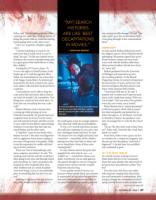
A scene from Blood Vessel, an Australian horror
film about a boat filled with Nazi vampires.
Barkan oversaw the film’s VOD distribution
this year.
THE HORROR COLLECTIVE