

Views
Jewfro
Borrowed Time:
Chicago Hope
M
y brother-in-law
Marc Rosenzweig
was diagnosed with
Stage 3 Hodgkin’
s Lymphoma in
2012 and Stage 4 lung cancer
in 2013. Borrowed Time is
a storytelling
project about his
journey to the
present as told to
me by him.
MARCH 18, 2017
I’
m standing in
a small, dark
room. I could not be more
relieved.
First, just being upright
feels like an act of defiance.
I’
ve spent so much of the last
six months lying on my back.
Last year, the doctors at the
University of Michigan tumor
board wouldn’
t approve brain
surgery because they thought
it would leave me paralyzed.
Turns out, they were only half
right.
My new doctors at
Karmanos Cancer Center
removed the tumor from my
brain in October, and what did
I have to show for it? Twenty-
six staples running the length
of my skull, immobility on
the left side of my body, 6,300
songs in my iTunes library and
plenty of time to listen to them
in my childhood bedroom.
Actually, the bedroom my
brother and I shared 30 years
ago now has an Airdyne bike
and sewing machine. The
cork-lined wall is gone, along
with the Styx and Journey
ticket stubs, the miraculous
USA Hockey Sports Illustrated
cover, the tasteful Farah
Fawcett poster.
I moved into my sister’
s
old room, which still has the
state-of-the-art 1973 Nutone
intercom built into the wall.
It doesn’
t work anymore, so
instead of my mom yelling
into the mic (always yelling)
for us to get up already and get
to school, I’
d call my parents
upstairs when I needed their
help in the middle of the night.
Or, if I was too hoarse to
speak, text with my good hand.
What’
s that you say, iTunes
shuffle play? I should take
a road trip? Seems totally
rational to usher in spring with
a road trip. That would be the
perfect way to trade the well-
wishers and worriers at home
for the freedom of the open
road.
Back in November, I was
dying. Chemotherapy had
become too toxic. The next
best option was to wait for
a phase II clinical trial for a
cancer inhibitor that might
keep the irrepressible cancer
cells from congregating into
another tumor.
Once I was admitted to a
drug trial in January and my
fevers subsided in February, I
didn’
t feel like I was dying. But
I definitely didn’
t feel like I was
living either.
Plus, I had a ’
99 Corvette
convertible parked 20 feet
from my bed. All winter, my
dad had been starting the car
regularly to make sure it would
run when I was cleared to
drive. He was less confident in
my ability to take it to Chicago
and then Colorado, Phoenix
and California.
The mechanic that I spoke
to admired my ’
Vette — and
my drive — but expressed
doubt about putting on a hitch
to pull a wheelchair across the
country.
If the roundabouts on
Orchard Lake Road were any
indication, 5,000 miles started
to seem ambitious, even with
designated drivers who had
offered (or been offered)
to drive and house me for
different legs of the trip.
But I couldn’
t get Chicago
out of my head. The city, not
the band. My son Sammy is a
sophomore studying graphic
design at Columbia College. I
suggested that we go to the Art
Institute, and he told me he’
s
been there “a number of times.”
I had an old friend in Glencoe
and a sense that Whitesnake
was singing about me.
Here I go again on my own
Goin’
down the only road I’
ve
ever known
Like a drifter, I was born to
walk alone
And I’
ve made up my mind
I ain’
t wasting no more time.
So I’
m relieved to be upright.
I’
m relieved to be in this unlit,
unfamiliar room in Sammy’
s
South Loop apartment.
Relieved for my time on the
road, might as well have been a
dog with his head stuck out the
window. I didn’
t even mind the
looks I’
d get — first indignant,
then pitying — when I parked
my fast car in a handicapped
spot and then slowly hobbled
out, as if the heavy plastic boot
on my foot explained both.
I didn’
t bring a wheelchair,
but there was a hitch ... my
bladder hasn’
t been the same
since chemo.
From the suburbs, I had
realized I was going to be
cutting it close. I put my faith
in Waze, braced myself for
Chicago traffic and made sure
Sammy had the garage door
open so I could zip up the
circular ramp.
I’
m relieved to be relieving
myself. Even if I didn’
t make
it down the hall to Sammy’
s
bathroom. I had to go. I went.
I took no pleasure in the warm
sensation of wetting myself
and whatever I was standing
on, but I feel no shame. ’
Cause
I know what it means ... to
walk along the lonely street of
dreams.
“Sammy, I need to borrow a
change of clothes. Where are
your pants?”
“You’
re standing on
them.”
You can read more reports about
Marc’
s life, heroically recounted and
humbly submitted, beginning next
month at thejewishnews.com.
OCTOBER 15 • 2020 | 5
Ben Falik
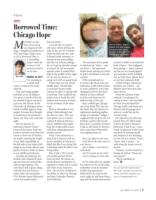
The top of Marc’
s head in
October 2016 after surgery
to remove a brain tumor;
and Marc in March 2017 in
Chicago with son Sammy
BEN FALIK