

30 | OCTOBER 15 • 2020
Arts&Life
music
Goes
Chamber
Music
Virtual
Harpsichordist Andrew Appel
to play free online concert.
SUZANNE CHESSLER
CONTRIBUTING WRITER
A
ndrew Appel was 16 when he was
able to bring a harpsichord into
his New York City home while
preparing for a career as a musician.
Now, at 69, and with the use of
technology, he virtually is able to bring
lots of guests into his home, 100 miles
outside New York City, to hear him at
the instrument that became his favorite
as both soloist and member of the Four
Nations Ensemble.
Appel’
s next concert — free and
beginning at 8 p.m. Thursday, Oct.
15 — is planned as part of a series by
the Chamber Music Society of Detroit
(CMSD) as the organization, like so
many other music presenters, has moved
into the digital sphere because of the
pandemic.
Appel will feature five works by
17th- and 18th-century French and
German composers and speak about
each piece before playing it. The first two
pieces, by Louis Couperin and Johann
Jakob Froberger, offer varied personal
expressions related to a stunning shared
experience.
“Couperin and Froberger were at a
party, and a famous lutenist fell down a
flight of steps and died,” Appel said. “Both
composers [separately] wrote elegies in
the lutenist’
s honor, and both pieces are
really beautiful. It’
s so interesting to have
the pieces side by side.”
The rest of the hourlong program
features suites that have their individual
stories, which will be conveyed by the
harpsichordist. The works are by Georg
Böhm, J.C.F. Fischer and J.S. Bach. The
performer will delve into how Böhm
brings the sweet and lyrical expression of
French composers into his writing while
Fischer is more contemporary.
“I picked these pieces because I really
love them,” said Appel, who explained
that he came to love the harpsichord
because it has a more complex sound
than the piano, which he studied first.
“The harpsichord is more complicated
and brain-filling. On the piano, you never
feel the string. On the harpsichord, I
actually feel the plucking of the string
with every note, and my connection to
the sound is a little more like a guitarist’
s
connection to the sound.”
Before being able to have his own
harpsichord as a teenager, Appel put
thumb tacks on the hammers of his piano
to create a metallic sound that brought
the effect of the piano closer to the
harpsichord.
Appel’
s interest in classical music
started when he was a preschooler who
enjoyed listening to his mother’
s record
collection. In school, he worked at his
grandfather’
s garment business for the
money to buy records of his own.
Appel, who had formal training at
DAVID RODGERS
DAVID RODGERS
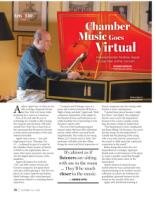
Andrew Appel at
the harpsichord.
It’s almost as if
listeners are sitting
with me in the room
... They’ll be much
closer to the music.
— ANDREW APPEL