

A
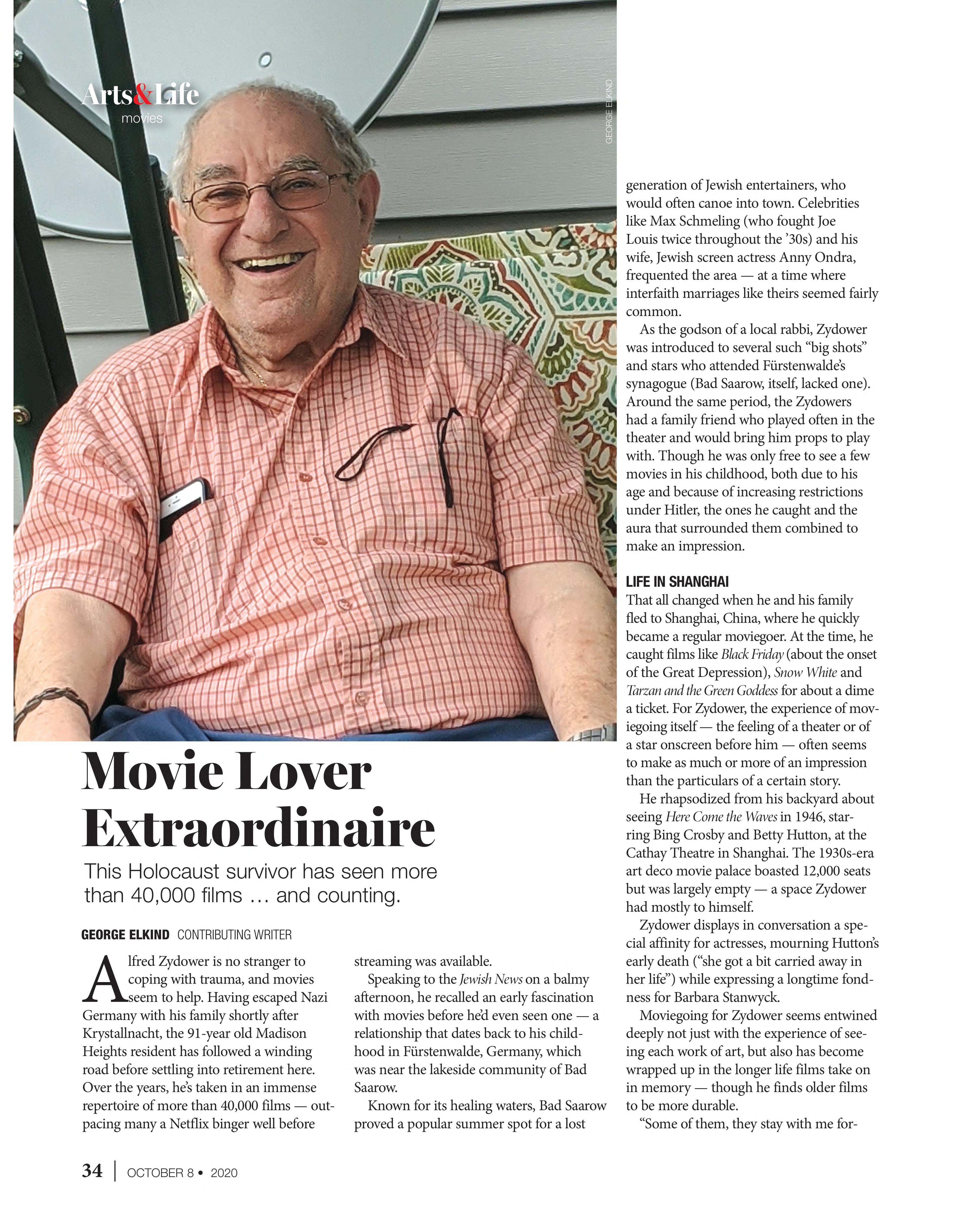
lfred Zydower is no stranger to
coping with trauma, and movies
seem to help. Having escaped Nazi
Germany with his family shortly after
Krystallnacht, the 91-year old Madison
Heights resident has followed a winding
road before settling into retirement here.
Over the years, he’
s taken in an immense
repertoire of more than 40,000 films — out-
pacing many a Netflix binger well before
streaming was available.
Speaking to the Jewish News on a balmy
afternoon, he recalled an early fascination
with movies before he’
d even seen one — a
relationship that dates back to his child-
hood in Fürstenwalde, Germany, which
was near the lakeside community of Bad
Saarow.
Known for its healing waters, Bad Saarow
proved a popular summer spot for a lost
generation of Jewish entertainers, who
would often canoe into town. Celebrities
like Max Schmeling (who fought Joe
Louis twice throughout the ’
30s) and his
wife, Jewish screen actress Anny Ondra,
frequented the area — at a time where
interfaith marriages like theirs seemed fairly
common.
As the godson of a local rabbi, Zydower
was introduced to several such “big shots”
and stars who attended Fürstenwalde’
s
synagogue (Bad Saarow, itself, lacked one).
Around the same period, the Zydowers
had a family friend who played often in the
theater and would bring him props to play
with. Though he was only free to see a few
movies in his childhood, both due to his
age and because of increasing restrictions
under Hitler, the ones he caught and the
aura that surrounded them combined to
make an impression.
LIFE IN SHANGHAI
That all changed when he and his family
fled to Shanghai, China, where he quickly
became a regular moviegoer. At the time, he
caught films like Black Friday (about the onset
of the Great Depression), Snow White and
Tarzan and the Green Goddess for about a dime
a ticket. For Zydower, the experience of mov-
iegoing itself — the feeling of a theater or of
a star onscreen before him — often seems
to make as much or more of an impression
than the particulars of a certain story.
He rhapsodized from his backyard about
seeing Here Come the Waves in 1946, star-
ring Bing Crosby and Betty Hutton, at the
Cathay Theatre in Shanghai. The 1930s-era
art deco movie palace boasted 12,000 seats
but was largely empty — a space Zydower
had mostly to himself.
Zydower displays in conversation a spe-
cial affinity for actresses, mourning Hutton’
s
early death (“
she got a bit carried away in
her life”) while expressing a longtime fond-
ness for Barbara Stanwyck.
Moviegoing for Zydower seems entwined
deeply not just with the experience of see-
ing each work of art, but also has become
wrapped up in the longer life films take on
in memory — though he finds older films
to be more durable.
“Some of them, they stay with me for-
Arts&Life
movies
34 | OCTOBER 8 • 2020
Movie Lover
Extraordinaire
GEORGE ELKIND CONTRIBUTING WRITER
This Holocaust survivor has seen more
than 40,000 fi
lms … and counting.
GEORGE ELKIND