

22 | OCTOBER 8 • 2020
A Place of Their Own
Group neighborhood provides independence to adults with disabilities.
JENNIFER LOVY CONTRIBUTING WRITER
Jews in the D
L
osing a sister to breast cancer forced
Melanie Cohen to address the ques-
tion that keeps every parent of a child
with a disability awake at night: “Who will
take care of my child when I’
m gone?”
Watching her nieces and nephew become
orphans, Cohen suddenly realized the
importance of making and implementing a
long-term plan for her 23-year-old autistic
son Spencer. Although she and her husband
are healthy and Spencer has a younger
brother, Cohen felt it was important to find
housing that would give Spencer his inde-
pendence and allow him to live in an envi-
ronment where he would not feel isolated.
While researching options, she came
across the concept of an intentional com-
munity and felt it would be the best living
situation for her son. The idea intrigued her
because Spencer could live with his peers
in housing that would be walking distance
from shopping and a potential place for
him to work, which is especially important
since he does not drive. Plus, living among
the residents, there would be a community
builder whose part-time job would be to
mediate roommate disputes, etc.
While the concept was intriguing, there
were no local options. Cohen, who lives
in West Bloomfield, joined a handful of
like-minded moms who were creating an
intentional community. They shared a
vision, agreed on a mission statement, and
ultimately formed a nonprofit organiza-
tion called Integrative Neighborhoods of
Oakland County.
The group has seven young adults
with varying degrees of disabilities, all
living in three apartments in Hunters
Ridge Apartments and Townhouses, in
Farmington Hills. They are also looking
to expand to other areas around Oakland
County and collaborating with almost a
dozen families looking to establish an inten-
tional community east of Woodward.
In the Hunters Ridge Apartments, each
resident has a daytime caregiver providing
a set number of hours per week. The res-
idents also work or attend a day program.
For example, Spencer has a job cleaning at
West Bloomfield High School and has state
funding for a caregiver to spend 20 hours a
week with him.
When Spencer isn’
t working, he likes to
ride his bike around the neighborhood or
walk to one of the nearby stores, where he
regularly buys a diet Coke. He also enjoys
participating in game nights organized by
his roommate Stanley Wolf.
During the summer, these bi-weekly
Saturday night gatherings took place outside
because of COVID. As the temperatures
dropped, game night moved to an online
format. There was also talk of starting
Shabbat dinners (four of the seven residents
are Jewish) but until there is a vaccine,
Friday night dinners are on hold.
Spencer and Wolf share a three-bed-
room apartment with one other roommate.
According to Wolf, they’
ve lived there for
one year and five months and love their
independence.
“I can do what I want, and I have good
roommates,
” said Wolf, who likes to go
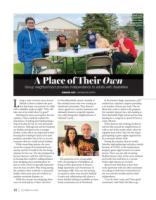
PHOTOS COURTESY OF INTEGRATIVE NEIGHBORHOODS OF OAKLAND COUNTY
Melanie Cohn and
Spencer Cohn
Getting ready for game night:
Jonathon Reinheimer, Reed
McAlphia, Spencer Cohn,
Stanley Wolf, Adam Garfield
Turner and James Pentis.