

20 | OCTOBER 8 • 2020
W
hen Sam Bagenstos heard
the news about the death of
Supreme Court Justice Ruth
Bader Ginsburg, he was in the middle of a
Rosh Hashanah service on Zoom and was
instantly overcome with emotion.
“Tikkun olam is a principle
and a practice that mattered a
lot to the justice, and it’
s some-
thing I think she’
s passed along
to a new generation, even for
those who don’
t know or use
that term,
” Bagenstos said.
Bagenstos, a civil rights law-
yer and professor of law at the University
of Michigan, served as a law clerk for
Ginsburg from 1997-98, and is one of many
Detroit-area connections and admirers of
Ginsburg mourning her recent passing.
“She was always incredibly meticulous
about getting the cases right. She worked
20-hour days and inspired you to work
as hard as she did,
” Bagenstos said. “We
worked on some quite significant cases and
some cases nobody has heard of, but she
took all the cases equally seriously.
”
Ginsburg was appointed to the high court
in 1993 and was the first Jewish woman and
only the second woman ever to become
a justice. Ginsburg was one of the most
important figures in fighting for gender
equality in U.S. history.
While Ginsburg was known for being
stoic and focused, Bagenstos’
experiences
with the justice give a peek into who she
was on a personal level and how much she
cared for her law clerk family.
“The first case I argued in front of the
Supreme Court, I lost 9-0,
” Bagenstos said.
“She wrote me a note when the opinion
came out about how great I was in the argu-
ment, and it was really all about the side I
was on and not about my lawyering. I really
appreciated that.
“Often, when I would file a brief in the
court, she would write me a little note with
some kind of funny joke about a line in the
brief I wrote, showing me she had read the
brief very carefully,
” Bagenstos continued.
Bagenstos married another law clerk of
Ginsburg’
s, Margo Schlanger, and it was
through their shared link to Ginsburg that
they connected.
Schlanger was a clerk of Ginsburg’
s from
1993-95 and was looking to
work at the Justice Department
once her clerkship was over.
In a conversation with former
Massachusetts Gov. Deval
Patrick, who headed the civil
rights division of the Justice
Department at the time,
Ginsburg mentioned Schlanger as someone
he should interview for a job.
In return, Patrick mentioned the name of
Bagenstos, a young lawyer at the time work-
ing under Patrick, as someone Ginsburg
should interview to become one of her
clerks. Bagenstos hadn’
t even applied for the
job. They were both hired in their respec-
tive roles.
Bagenstos and Schlanger eventually start-
ed going out to lunch every week to main-
tain open lines of communication.
“One thing led to another and we fell in
love, and in the middle of my clerkship I
proposed, and Margo said yes,
” Bagenstos
recalled. “When I told Justice Ginsberg, it
really was the happiest I’
d ever seen her.
”
Schlanger, also a professor of law at the
University of Michigan, applied to work for
Ginsburg on the D.C. Circuit prior to her
SCOTUS appointment because Ginsburg
was already such a hero in regards to gen-
der rights.
“The guiding principle for Justice
Ginsburg was that men and women should
be equal, not only when they do the things
you’
d expect men and women to do,
but however they choose to be men and
women,
” Schlanger said.
“I was a women’
s history major in college.
The importance of this kind of an idea
Sam
Bagenstos
Ginsburg’s
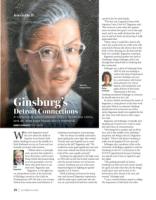
Detroit Connections
A romance sparked between RBG’
s former law clerks,
and an artist pays tribute with a memorial.
DANNY SCHWARTZ STAFF WRITER
Jews in the D
COURTESY OF EDWARD STROSS
Mural by
Edward Stross
Margo
Schlanger