

OCTOBER 1 • 2020 | 31
Jerusalem –
G
rowing up in Southfield,
Ruth Ebenstein always
felt energized by the
ethnic and religious diversity that
characterizes Metro Detroit life.
So when Ebenstein, who
moved to Israel in 1990, was
diagnosed with breast cancer 10
years ago, it felt natural for her
to join a Jerusalem breast cancer
support group for Jewish and
Palestinian women.
“When I found out about this
breast cancer support group, I
thought it would be a great way
to forge a connection,
” Ebenstein
said. “Breast cancer is a huge
thing to have in common.
”
In addition to seeking the
support group’
s advice and reas-
surance, Ebenstein was hoping to
find friendship.
“I was looking for someone
going through the same experi-
ence to connect with. I felt lonely
on this journey.
”
The woman she connected
with — to the point of feeling
like sisters — is Ibtisam Erekat,
a Palestinian breast cancer sur-
vivor who lives in Abu Dis, a
Palestinian village on the other
side of Israel’
s soaring security
barrier that separates the West
Bank from Jerusalem.
As the political impasse and
mistrust between Israelis and
Palestinians has grown, so has
their devotion to each other.
Erekat, a devout Muslim, and
Ebenstein, a Modern Orthodox
Jew, have much more than breast
cancer survival in common.
Both were in their 30s when
they married divorced men with
children, and both gave birth to
three children within three years.
And they both believe that love
can overcome hate.
“Ibtisam is so comfortable with
herself, something we have in
common,
” Ebenstein said. “She’
s
strong-willed in the best sense;
she has her own opinions. She’
s
warm, has a wonderful sense of
humor and incredible faith.
”
Soon, they began meeting out-
side the confines of the support
group, woman-to-woman, and,
later, family-to-family.
Their common language is
English.
“We talk about everything,
”
Ebenstein said. When they talk
about the “hard stuff” — terror
attacks, wars — they discuss how
these events relate to their per-
sonal lives.
During the 2014 Israel-Gaza
war, for example, the friends
leaned on each other for
emotional support as Hamas
launched thousands of mortars
and rockets into Israel, and the
IDF retaliated, decimating parts
of Gaza.
On a day-to-day level, “if I
hear of something that happened
in Abu Dis, I’
ll check in and
see if she’
s OK,
” Ebenstein said.
“Ibtisam does the same for me.
”
WIDENING HORIZONS
Erekat initially joined a
Palestinian support group, and
then joined the Jewish Israeli-
Palestinian group through the
Patient’
s Friends Association at
Augusta Victoria Hospital in
eastern Jerusalem.
“It was a beautiful experience
where we got to know a group
of Israeli and Arab women,
” she
said.
She was struck by Ebenstein’
s
warmth and desire to help
Palestinian group members.
“She treated me with great
respect and helped me in several
situations,
” Erekat said. The more
time they spent together, the
more their friendship blossomed.
“I got to know her family, her
father, mother, sister and two
brothers, and also her husband
Yonatan. He is a very fun person
and respects me, and I appreciate
this about him. I respect them,
and love them all,
” Erekat said.
Eventually, the friendship
evolved into speaking engage-
ments in the U.S. and Israel.
Erekat and Ebenstein addressed
groups, large and small, about
their unique relationship and
the fact that individual Israelis
and Palestinians have the power
to overcome ingrained hatred
by seeing each other as people.
They’
ve started giving talks over
Zoom to groups near and far.
“We’
re individuals,
” Ebenstein
said. “She’
s not Palestine. I’
m not
Israel. She’
s Ibtisam; I’
m Ruth.
”
Along the way, Ebenstein has
learned about Palestinian culture
— and suffering.
“Getting close to someone
across the divide has taught me
how much we don’
t know about
the ‘
other.
’
Getting close to some-
one makes you see how little you
know. It really hammers it home.
”
OVERCOMING SEPARATION
Erekat, who has asthma, lives
close to the Separation Barrier.
Sometimes there are skirmishes
between Palestinians and Israeli
military or border police, and the
tear gas wafts into her home.
“She can be vomiting for
hours from the tear gas, but if
you don’
t know anyone affected,
you wouldn’
t know that this
is happening,
” Ebenstein said.
“You don’
t realize an innocent
person sitting on her couch will
be sick for hours, or that many
Palestinians who are sick can’
t
get an entry permit into Israel for
much-needed medical treatment.
“
As a cancer survivor the
thought of not being able to get
treatment is frightening,
” both
for herself and Erekat, Ebenstein
said.
“We are an occupied people,
”
Erekat said. “
At first, when I got
to know Ruti, I could not visit
her at her home except with a
permit from the Israeli govern-
ment. Then the laws changed,
and I was allowed in without
a permit because I’
m over 50
years old. Now such a visit is
forbidden, possibly related to the
Coronavirus pandemic.
”
For the vast majority of
Israelis, Palestinians are “arbitrary
concepts,
” Ebenstein said. Having
a dear friend who is Palestinian
“changed so much for me.
”
Erekat feels the same way.
“We have our own bodies but
share one soul. We feel each oth-
er’
s pain and help each other in
many matters. Ruti is my sister
and best friend,
” Erekat said.
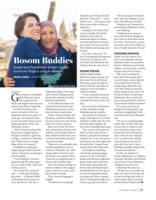
Bosom Buddies
Israeli and Palestinian breast cancer
survivors forge a unique alliance.
Eretz
MICHELE CHABIN CONTRIBUTING WRITER
Ruth Ebenstein and Ibtisam Erekat