

24 | SEPTEMBER 24 • 2020
A
t some point during the solemn Kol
Nidre service, Dr. Mark S. Roth,
president of Congregation B’
nai
Moshe, will step up to his designated micro-
phone in a practically empty sanctuary to
deliver the synagogue’
s annual fundraising
appeal. Roth, the clergy, a few Torah readers
and a handful of choir members will be the
only ones there.
This yearly campaign is one of the congre-
gation’
s prominent fundraisers, and, for the
first time, it’
s one that B’
nai Moshe members
will hear during a live-stream service.
Because of COVID-19, there will be no
packed sanctuaries or security guards direct-
ing traffic. Synagogues and temples will be
empty this year as Jews gather in front of
screens or at scaled-down outdoor services.
Congregation leaders spent the last several
months planning for High Holiday services
amid a global pandemic that prevents large
gatherings. Part of their planning included
how to address the various fundraising cam-
paigns that typically take place in conjunc-
tion with the start of the Jewish New Year.
Among the congregations responding
to the Jewish News’
inquiry about this year’
s
fundraising efforts, some indicated that
funds generated this year would be allocated
to help members impacted financially by
COVID. Others are giving dollars to capital
improvements and programming.
“We typically have a High Holiday Appeal
that is launched at the holidays,
” said Brian
D. Fishman, executive director of Temple
Shir Shalom. “This year will be no exception
except that the money we raise will go to our
COVID-19 Emergency Fund campaign.
”
Similarly, Alan Yost, executive director
of Adat Shalom Synagogue, said money
generated from this year’
s appeal would help
the congregation provide membership dues
adjustments, religious school tuition schol-
arships, camp tuition assistance and other
needs based on financial need. Funds raised
in years past went to projects such as build-
ing upgrades and renovations and purchas-
ing new siddurs for the congregation.
At B’
nai Moshe, campaign revenue will
“help move the synagogue forward rather
than maintain the status quo,
” Roth said.
“We’
re trying to develop innovative pro-
grams to attract more young adults and
young families to the synagogue as well as
cover the costs of routine expenses.
”
Before making his pitch for donations,
Roth will spend a few minutes thanking
clergy and leadership for making necessary
modifications to meet the congregation’
s
needs, especially during the High Holidays.
“They recognized that no one was going
to sit in front of a screen for five hours, and
they worked hard to shorten the service
while maintaining the traditions. It’
s a lot
like in ancient times when Judaism could
have died out after the temple’
s destruction
but didn’
t. They modified and persevered.
”
ISRAEL BONDS’
VIRTUAL TABS
The impacts of High Holiday fundraising
will also be felt by Israel Bonds and Yad
Ezra, as both entities have in-service appeals.
However, the unprecedented online connec-
tivity will allow Israel Bonds to reach out to
a broader audience through virtual tab cards
and a video message.
According to Israel Maimon, president
and CEO of Israel Bonds, $100 million in
bonds are typically sold during the High
Holiday period. During this pandemic, his
goal is to maintain that level, he said.
This year marks the 29th anniversary of
Yad Ezra’
s holiday appeal, in which congre-
gants bring bags of nonperishable food and
monetary donations to Kol Nidre services.
Typically, the organization collects
between 24,000 and 28,000 pounds of food.
This year flyers went out asking that collect-
ed food be dropped off at the food bank.
Some congregations requested envelopes to
distribute to members.
While it’
s not Yad Ezra’
s largest fundrais-
ing campaign, the holiday appeal is crucial
because it helps the organization raise
awareness and maintain community visibil-
ity.
“The beauty of the food drive is that it’
s a
way to remind people to teach their children
that there are others who are struggling and
people who don’
t have a choice of three dif-
ferent kinds of cereal in the morning,
” said
Lea Luger, executive director of Yad Ezra.
“
As an organization, we can buy cereal
cheaper than a family donating it, but this
is a way to remind children that there are
people in need.
“While our High Holiday appeal does
help support our bottom line, it’
s more of an
educational promotion.
”
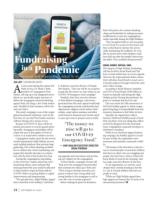
Synagogues and organizations adjust to an unusual year.
JEN LOVY CONTRIBUTING WRITER
“The money we
raise will go to
our COVID-19
Emergency Fund.”
— SHIR SHALOM EXECUTIVE DIRECTOR
BRIAN FISHMAN
in a
Fundraising
Pandemic
Yom Kippur