

22 | SEPTEMBER 24 • 2020
C
OVID-19 has changed
many aspects of life,
including religious ser-
vices.
Since state restrictions on
public gatherings continue,
many local synagogue and
temple buildings continue to be
closed. This poses a challenge
for meeting the traditional
Jewish requirement of daily
prayers with a minyan — a
quorum of at least 10 men pray-
ing together. (Non-Orthodox
congregations typically count
women in their minyanim.)
The minyan symbolically rep-
resents the community of Israel
and is required for reciting the
Kaddish and other prayers, as
well as reading from the Torah.
Some Orthodox congrega-
tions are holding small minya-
nim and Shabbos services out-
side their buildings, sometimes
under tents, or inside their
facilities in small numbers.
“We are hosting in-person
minyanim, with masks, dis-
tancing and a limited number
of attendees in our large main
sanctuary and social hall,
” said
Rabbi Shaya Katz of Young
Israel of Oak Park.
“Davening outside has been
very beautiful,
” said Rabbi
Shneur Silberberg of Bais
Chabad Torah Center in West
Bloomfield. “Our daily minyan
is stronger than in the past, per-
haps because some shuls are not
doing it.
”
However, many local
Conservative and a few Reform
congregations are using digital
platforms like Zoom, Facebook
and YouTube to offer virtual
minyanim. Some link to their
services via a password-protect-
ed site or a personal email to
discourage hackers. While some
worshipers miss the contact of
an in-person minyan, others
find them more convenient.
Congregation B’
nai Moshe
in West Bloomfield has done
well with online minyanim.
Executive Director Steven Fine
said, “We do get a minyan of
Zoom participants most every
morning and our afternoon
Zoom minyanim sees anywhere
between 20 and 40 participants
every day. This is attended in
greater number than when we
had in-person services.
“While many were not able
to attend our 6 p.m. services
in person, some have become
regulars over the last six months.
We’
ve had people join our after-
noon minyan from as far away
as Arizona and California. We
have built a wonderful online
community of caring individuals
through this most difficult time.
”
Rabbi Aaron Bergman at
Adat Shalom Synagogue, a
Farmington Hills Conservative
congregation, said, “We are
Zooming seven days a week,
twice a day. Minyan attendance
for each service has been strong
and consistent.
”
Conservative Congregation
Shaarey Zedek in Southfield has
offered morning and afternoon/
evening minya
n on Zo
om every
day since March. “Our weekday
minyan numbers are twice what
they were when we met in per-
son,
” said Rabbi Aaron Starr.
At B’
nai Israel Synagogue, a
Conservative congregation in
West Bloomfield, a daily online
minyan includes the Mourner’
s
Kaddish, if there are 10 par-
ticipants, but not the other
Kaddishes or Torah readings.
Congregation Beth Ahm in
West Bloomfield follows a simi-
lar course.
Several Reform congrega-
tions including Temple Beth
El, Bloomfield Township, and
Temple Israel, West Bloomfield,
offer weekly virtual minyanim.
Jewish halachic tradition
prohibits using technology on
the Sabbath and high holidays.
Most Orthodox congregations
have continued to abide by that
restriction during the pandem-
ic. The Conservative Rabbinical
Assembly issued a paper outlin-
ing ways to use Zoom and other
online technology for Shabbos
and Yom Tov, and made the
paper available on its website.
Rabbi Bergman, a recent
past president of the Michigan
Board of Rabbis, said, “There
were a lot of discussions among
Conservative Rabbis. Ultimately
this has been considered to be
an unusual emergency situation
where we had to be very cre-
ative in keeping the community
connected to their Judaism and
spiritual lives. Every synagogue
has taken a slightly different
approach, but we all felt the
pandemic forced us into a situa-
tion that we would not normal-
ly have endorsed.
”
B’
nai Israel’
s Rabbi Mitch
Parker said that people missed
Shabbat services, so they insti-
tuted an online service. He
added, “We tried to maintain the
sanctity of Halachah and the day
by asking members to turn on
their computers to a Zoom site
on Friday night before Shabbat.
”
Members can access the service
without turning anything on or
off and without touching any
computer keys.
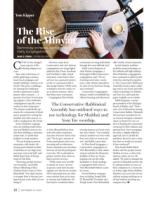
The Conservative Rabbinical
Assembly has outlined ways to
use technology for Shabbat and
Yom Tov worship.
Yom Kippur
The Rise
of the Minyan
Technology increases participation in
many congregations.
SHARI S. COHEN CONTRIBUTING WRITER