

Looking Back
From the William Davidson Digital Archive of Jewish Detroit History
accessible at www.djnfoundation.org
L’ Shanah Tovah Through the Years
I
read an article with a good line
that summed up Rosh Hashanah
in 2020/5781 — “The Shofar will
be heard in new ways.
” Indeed, the
High Holiday season this year will
be during a still-to-be-conquered
COVID-19 pandemic. There will be
new ways of celebrating, including
Zoom services on your computer
and masks on the end
of shofars. Regardless
of how they have
evolved, the High
Holidays have survived
for centuries and a
pandemic won’
t stand
in their way, not now
or in the future.
Every year, over
the past century, the JN (since
1942) and the Detroit Jewish Chronicle
(1916-1951) have published Rosh
Hashanah stories and announce-
ments. So, I thought I would visit the
William Davidson Digital Archive
of Jewish Detroit History to see
how the front pages from Detroit’
s
Jewish newspapers devoted to Rosh
Hashanah have evolved with the hol-
iday over the years.
I began with 1920, after the last
surge of the Spanish Flu and two
years after WWI had ended. The
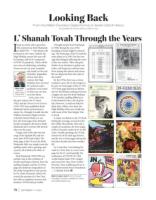
front page of the Chronicle for Rosh
Hashonah 5681 was simple (note the
spelling used), with a greeting, and
a poem, all in black and white, of
course.
Rosh Hashanah 1945/5706 was
another step in the evolution of
Jewish reporting in Detroit. First, the
spelling changed, and the JN’
s front
page also featured a large photo of
the shofar being blown and a poem
by Dr. Noah Aronstam, which wel-
comed the promise of a New Year,
but with an emphasis on peace and
freedom. WWII had just ended.
I thought maybe Rosh Hashanah
in 1948, during the year of the
founding of Israel might be interest-
ing. The front page of the JN used the
same photo as in 1945, but the mes-
sage had changed reflecting the cause
of the new nation: “Blow the great
shofar of our freedom to gather our
exiles, and bring our scattered ones
from among the nations and assem-
ble our dispersed from the ends of
the world.
”
By the 1970s, there was a minor
evolution: just a bit of color began to
be seen on front pages of the JN. The
1973 front page featured an illustra-
tion by Saul Raskin wishing everyone
a happy new year for Rosh Hashana
5734 (another spelling difference).
It also featured color, a bit of green
ink. However, I could not help but
think that, within a few days, the
High Holidays that year would end
with onset of the Yom Kippur War
in Israel.
A major revolution in the JN’
s Rosh
Hashanah coverage occurred in the
late-1980s. Henceforth, with only a
couple of exceptions, the front pages
of the JN became works of art, in full
color. Visually speaking, the JN had
moved out of the dark ages forever
and the art on front pages during the
last three decades has been wonder-
ful.
As I write this, I am looking for-
ward to a New Year, to a new cover
page for the JN, and hopefully, the
eradication of COVID-19. That
would indeed make 5781 a happy
and sweet New Year. From Arthur
Horwitz, Tessa Goldberg and me at
the Detroit Jewish News Foundation
— L
’
Shanah Tovah.
Want to learn more? Go to the DJN
Foundation archives, available for free at
www.djnfoundation.org.
Mike Smith
Alene and
Graham Landau
Archivist Chair
78 | SEPTEMBER 17 • 2020