

32 | SEPTEMBER 17 • 2020
S
ome events appear to spread the coro-
navirus more efficiently than others.
Blowing the shofar — without ade-
quate precautions — may be one of them.
Drs. Adam Schwalje and Henry T.
Hoffman, both professional otolaryngolo-
gists at the University of Iowa and amateur
bassoon players, said that playing a musical
instrument, even a shofar, could propel
virus-laden droplets into the air. Schwalje
told the Times of Israel that the playing or
hearing the shofar “may pose an infection
risk.
”
The doctors told a conference at the
University of Iowa School of Music that at
one choir performance in Amsterdam ear-
lier this year, 102 of the 130 singers came
down with coronavirus infections. Experts
say that shouting, or singing, or even
talking loudly in a room, propels droplets
into the air causing others to breathe in
the virus and develop their own infections.
Scientists suspect that aerosols from breath,
even smaller than droplets, travel farther
and stay airborne longer and can convey
the virus in poorly ventilated spaces as well.
Schwalje said sounding the shofar out-
of-doors would mitigate the risk, as would
standing at a distance from listeners, and
pointing the wide end away from them.
Cyrille Cohen, head of the immuno-
therapy laboratory at Bar-Ilan University
in Israel and a veteran shofar-blower, addi-
tionally recommends attaching a face mask
to the wide end of the shofar.
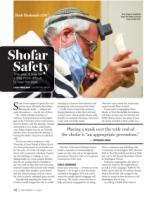
The New York-based Orthodox Union
issued a statement recommending the
mask over the wide end as “an appropriate
precaution,
” but not to rely on it to prevent
transmission of the virus.
PUBLIC SOUNDINGS
Every year, some Jews — at home or in the
hospital — do not get to hear the shofar
sounded in synagogue. This year, many
more who usually attend synagogue will
stay away. The Jewish community has to
help, and many congregations are doing
what they can to make this joyful noise
sound around Metro Detroit.
Conservative Congregation B’
nai
Moshe in West Bloomfield, for instance,
will share services over the internet, but
Rabbi Shalom Kantor also plans to have
the shofar sounded in three public loca-
tions: a commons area of Rolling Oaks
Community in Farmington Hills, Bloomer
Park in West Bloomfield and Burton Field
just next to the Burton Elementary School
in Huntington Woods.
Orthodox congregations also plan to
sound the shofar in the neighborhood
as well as at the synagogue. Rabbi M. M.
Polter reports that the Woodward Avenue
Shul in Royal Oak will arrange for the
shofar to sound in three locations in the
Huntington Woods area.
According to Rabbi Shaya Katz of
Rosh Hashanah 5781
Ruvi Singal of Southfield
blows the shofar at Young
Israel of Oak Park.
JERRY ZOLYNSKY
Shofar
Safety
This year, it may be
a little more diffi
cult
to hear the blast.
LOUIS FINKELMAN CONTRIBUTING WRITER
Placing a mask over the wide end of
the shofar is “an appropriate precaution.”
— ORTHODOX UNION