

54 | SEPTEMBER 3 • 2020
Looking Back
From the William Davidson Digital Archive of Jewish Detroit History
accessible at www.djnfoundation.org
75th Anniversary of VJ Day
T
here is another important 75th
anniversary this week. On Sept.
2, 1945, on the deck of the battle-
ship U.S.S. Missouri, the Japanese Empire
formally signed the papers of surrender
to the Allies. World War II was officially
over.
The fighting in the Pacific Arena had
actually ended earlier in
August 1945 when atom
bombs were dropped
on the Japanese cities of
Hiroshima and Nagasaki
on Aug. 6 and 9 respec-
tively. A few days later, in a
radio broadcast on Aug. 15,
Japanese Emperor Hirohito
announced that Japan had
surrendered. That day marked the end of
the fighting in the Pacific and was cele-
brated around the world as Victory over
Japan Day, or VJ Day.
Victory in Europe Day, or VE Day,
had occurred three months earlier on
May 8, 1945. This was, perhaps, a more
poignant moment for Jews, for those who
remained alive in Europe, and for those
in America and Detroit, because VE Day
meant the end of Hitler and the Nazis
and, therefore, the end of the Holocaust.
But we should not forget that Detroit
Jews were also deeply involved in the war
in the Pacific.
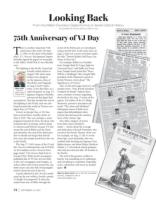
The Aug. 17, 1945, issues of the JN and
the Chronicle celebrated the end of WWII.
As the headline on the Chronicle’
s front
page stated: “City’
s Jewry Hails End of
Greatest War.” Both Jewish newspapers
published lists of VJ Day services held
at the city’
s synagogues and temples, as
well as other such events around the city.
Both issues were also full of meaningful
articles about the end of the war.
A great editorial in the Chronicle neatly
sums up the war within a Jewish context:
“
A People Unconquered.” It takes the
reader from rise of Hitler through the
events of the Holocaust as it developed,
using a Jewish lens. In the same issue on
page 2, there are a series of articles under
the title: “Detroit Rabbis Hail Peace; See
Dawn of New Era.”
For example, Rabbi Leo Franklin
from Temple Beth El “Urges Fight for
Universal Peace” and Rabbi Leo Fram
from Temple Israel noted that “Peace
Will be a Challenge.” Mrs. Joseph Welt,
president of the National Council of
Jewish Women, wrote about “The
Significance of Victory.”
Also on the front page, however, was
another story: “Four Jewish Scientists
Credited for Bomb.” Indeed, there
were a number of stories regarding
the bomb in the Aug. 17 issues of the
papers. The Editor of the JN, Philip
Slomovitz, penned a preceptive edi-
torial: “The Atom and Mankind.”
Subsequent issues of both news-
papers that fall published other
articles that discussed the ramifica-
tions of the Atomic Age.
One other category of stories
from these issues should be
noted — stories about the courage
and dedication of Jewish Detroiters who
served in the Pacific Theater of the war.
For example, on Aug. 17, the JN wrote
about Sgt. Louis Kaminsky, who was
credited with downing six Japanese Zero
fighter planes, and about Major Mordecai
Fralick, a U-M medical school graduate,
who had just returned after 38 months in
the Pacific.
The end of the greatest conflict in
history was something to be celebrated,
and something to remember. Hopefully,
such a celebration will never be needed
again.
Want to learn more? Go to the DJN Foundation
archives, available for free at
www.djnfoundation.org.
Mike Smith
Alene and
Graham Landau
Archivist Chair
s