

36 | SEPTEMBER 3 • 2020
I
n Václav Marhoul’
s new
fairly literal and so “faithful”
adaptation of Jerzy Kosinski’
s
influential, contro-
versial novel The
Painted Bird, things
are mostly what they
seem. An unnamed,
orphaned refugee boy
(Kosinski described
him as a “
gypsy or
Jewish stray ... olive-
skinned, dark-haired and black-
eyed”) trudges between brief,
fragile harbors amid the remote
villages and elder forests of
Eastern Europe under fascism,
accepting any hospitality he can
find.
Over the film’
s near-three
hours, he’
s received both well
and poorly in
discrete episodes,
with true security
and stability prov-
ing elusive. The
large international
cast of the boy’
s
run-ins includes
Harvey Keitel, Udo
Kier and Stellan Skarsgård. The
Holocaust is felt as a constant
presence — but an atmospheric,
generally destabilizing one rath-
er than an immediate threat.
Marhoul follows the boy duti-
fully (he’
s played by Petr Kotlar),
but The Painted Bird’
s screen
adaptation never quite lives
inside its lead character’
s mind.
It could be the nature of stream-
ing this at home, but for this
viewer the experience of watch-
ing ran parallel to the character’
s
experience, never intersecting.
The film is stately, attractive
and precise — successfully con-
juring a sense of place and tone.
Yet many of its gestures feel dis-
tant. Call it the burden of pres-
tige, the influence of film-histor-
ical bigwigs like Tarkovsky and
Bergman.
This remove leaves viewers
aligned with the story’
s concerns
and the character’
s experiences
but not exactly “in” them. The
procession of hardship and vio-
lence onscreen is modulated by a
safe, too-tasteful distance for an
adaptation of an offbeat, trans-
gressive and perverse novel.
Bestiality, eye-gouging and
dimly ironized bloodshed all fea-
ture, and Marhoul’
s team shoots
them coolly, cutting swiftly over
dead-on depictions of violence
in a “
straight,” unglamorous way.
The 1965 novel is kind of a
morbid picaresque. Kosinski’
s
protagonist doesn’
t understand
what it’
s like to be deprived of
basic human dignity because
he knows of little else. It’
s this
juxtaposition — of the boy’
s
innocence with the adult reader’
s
more jaded perspective — that
makes for an immersive book: a
vision of Europe under fascism
delivered through a personal
lens (although the author’
s early
claim it was autobiographical
has been extensively contested).
The film adaptation is accom-
plished and often beautiful. It is
also the first major film to use
the hybrid constructed language
of Interslavic. But it’
s missing
something personal beyond the
inhumanity depicted onscreen.
Well-told though it may be, it’
s
ultimately a story we’
ve already
seen.
to help support local musicians
while giving people access
to the type of entertainment
they’
ve been missing,
” said
Witz, a Brandeis
University grad-
uate who also
has produced
Menorah in the D.
“
All events meet
current state of
Michigan event guidelines.
”
While live concerts are popu-
lar at the annual event, this year’
s
music will be offered Sept. 4-7
in a drive-in setting at 6th and
Main streets and online Aug.
27-Sept. 3 with nearly 200 per-
formances. Among the perform-
ers representing a wide range of
musical styles will be Thornetta
Davis, Laith Al-Saadi, Eva Under
Fire and Larry Lee & The Back
in the Day Band. Each drive-in
performance will deliver a pair of
30-minute, high-energy sets.
Concerts are planned to ben-
efit local music performers with
a total goal of raising $500,000,
made possible with the addi-
tion of matching grant funding
from Oakland County..
“We want to raise money
for a hard-hit industry,” Witz
said. “There will be application
forms for monetary assistance
for any musicians who have
agreed to perform in concert,
virtually or drive-in, if 50
percent of their employment
revenue came from the music
industry prior to COVID-19.”
The “Eats” part of Arts, Beats
and Eats will appear directly
in communities as food trucks
travel to unannounced areas.
“We’
re not announcing where
the trucks will be so we don’
t
overwhelm the neighborhoods,”
Witz said. “We’
re trying to
be creative, spread some fun
around and keep people safe
from a crowd perspective.”
Arts, Beats & Eats is main-
taining its associated health
activities for eventgoers, live and
online, while supporting people
who have been out of work.
A live Zumbathon
Celebration goes virtual
at 9 a.m. Saturday, Sept. 5.
Donations of $5 will benefit
Forgotten Harvest and the Beats
Go On GoFundMe campaign
for unemployed musicians.
“Stretch for a Cause, Yoga to
Live Music” begins at 9 a.m.
Sunday, Sept. 6, in the main
stage area. The family-friendly
program will feature live music
by Blackman/Wailin, and the
$15 donation fees will be split
among local yoga instructors
and musicians.
“We do not know how long
we’
re going to be dealing with
COVID-19, so I think it’
s
important to move the needle
forward in the event industry
in a safe fashion,” Witz said. “I
think the decisions we make
now in exploring creativity,
how to do things effectively and
what the public might be inter-
ested in will shape the future of
the industry.”
For more information on Arts, Beats
& Eats – live and virtual – go to arts-
beatseats.com.
ARTS, BEATS & EATS continued from page 35
ARTS, BEATS & EATS
Jon Witz
“We want to raise money
for a hard-hit industry.”
— JON WITZ
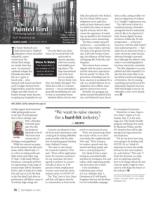
Petr Kotlár as
“A Boy” in the new
adaptation of Jerzy
Kozinski’
s novel
The Painted Bird.
Arts&Life
fi
lm review
GEORGE ELKIND CONTRIBUTING WRITER
‘The
Painted Bird’
Film adaptation is beautiful
but impersonal.
COURTESY OF IFC FILMS
Where To Watch
‘
The Painted Bird’
is
now available on VOD
rental for $6.99 from
all major providers.