

22 | SEPTEMBER 3 • 2020
W
hile the world continues to
understand COVID-19, how it
spreads and the impact it can
have on those who contract it, one of the
biggest concerns for pet owners is whether
or not pets can be impacted by the coro-
navirus.
“We are still learning new things about
this virus,” says Dr. Orit Szwarcman of
the Huntington Woods-based Home Vet
service, which provides veterinary care for
pets via home visits.
Dr. Szwarcman, 63, who started Home
Vet in 1990 and grew up in Brussels,
Belgium, has been practicing for 40 years.
The COVID-19 pandemic has caused her
to pivot and reshape how her services are
offered.
A member of Temple Emanu-El in Oak
Park, Dr. Szwarcman now only sees dogs
outside. She wears a mask and asks that
owners do the same. For cats, she sees
some outside, some in a garage and the
rest inside their homes.
These extra safety precautions can help
keep herself, pet owners and their pets
safe while the virus becomes more well-
known and understood by experts.
With many questions circulating about
pets and COVID-19, how to navigate pet
separation anxiety as owners return to
work and which risks exist (or don’
t exist)
for animals, Dr. Szwarcman answers some
of the most common concerns.
Q: Can pets contract or transmit
COVID-19?
A: As of now it appears that pets (and
some other species like lions and tigers)
can contract the COVID-19 virus from
positive humans. Thousands of animals
have been tested in the U.S. and only 20 or
so have tested positive. All were exposed
to positive people. Cats and ferrets seem
more susceptible than dogs. It does not
appear that pets play a role in people’
s
exposure, only that they can become posi-
tive through exposure to infected humans.
Q: Can the COVID-19 virus live in animal
fur?
A: Because pet hair is porous and fibrous,
it does seem highly unlikely that a person
could contract the virus by petting an
animal.
Q: Is it safe to walk dogs in high-traffic
areas during COVID-19 outbreaks?
A: The main problem would be encoun-
tering COVID-positive people not wear-
ing a mask. So I would avoid that type
of crowded situation. Maintaining a safe
distance is still the safer way.
Q: What precautions can people take to
keep their animals safe in public spaces?
A: Same as before. The risk, although pret-
ty small for your pet to get the virus, is
from positive people. Keep your pets away
from people not wearing masks.
Q: How should pet owners who have been
exposed to or contracted COVID-19
navigate quarantine and take care of their
pets?
A: Another person should take care of
the pets, who should be isolated from the
COVID-positive person. Ideally, a pet
emergency kit should be prepared with
food and medication (if they take any) for
about two weeks.
Q: Is it risky to take dogs or cats to groom-
ers or daycare/boarding?
A: A well-run boarding facility or day care
should not be a concern. Many groomers
have curbside pickup or drop-off service.
I have taken my own dogs to daycare and
the groomer.
Q: Should people limit their pets’
interac-
tion with other pets or animals?
A: That does not seem to be justified.
Unless one is COVID-positive.
Q: What steps can people take to keep
their pets healthy during this time?
A: Regular common sense to keep yourself
safe should apply. Make sure their routine
vaccinations and anti-parasite medications
are kept up. Wash your hands. Wear a
mask. Stay away from crowds.
Q: How can pet owners manage separation
anxiety with their animals as they return
to work?
A: After having been with their owner
24/7 for months, some pets might show
signs of separation anxiety. The first thing
to do is to try leaving the pet for increas-
ingly longer periods. Minimizing depar-
ture routine, not doing all the same things
in the same order when you’
re leaving,
avoiding making a big deal (especially
baby talk) when you leave or come back
— all those would be helpful to prevent
separation anxiety. If all fails, talk to your
veterinarian about medication. Or see a
veterinary behaviorist.
Pets
and the
Pandemic
Metro Detroit veterinarian
weighs in on pets and
COVID-19, separation
anxiety and more.
ASHLEY ZLATOPOLSKY CONTRIBUTING WRITER
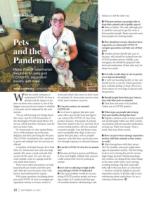
Dr. Orit
Szwarcman
and Sawyer
Jews in the D
JN FILE PHOTO