

16 | SEPTEMBER 3 • 2020
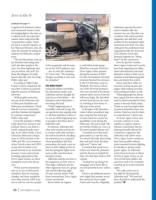
PHOTO COURTESY OF BECCA LUBOW
is against ICE detention centers
and commends Ocasio-Cortez
for bringing light to the issue on
a national scale, she expressed
caution when using terms like
“
concentration camps,
” which
are tied to a specific injustice. In
her Holocaust Memory class, she
starts the semester by asking the
students for Holocaust compar-
isons.
“The two that always come up
are abortions and eating meat,
and I ask other people in the
class, ‘
Are those legitimate and
can you tell me why not?’
For
those that disagree, it’
s really
hard to describe why it’
s wrong,
”
Pollin-Galay said.
According to Pollin-Galay,
Ocasio-Cortez’
s comparison fal-
ters when it refuses to acknowl-
edge the memory of Holocaust
survivors.
“With people’
s memories,
not just of the Holocaust, but
of Holocaust denialism and
Holocaust trivialization, I think
that the survivor community
and their families feel fatigued
by constant comparisons,”
Pollin-Galay said.
Caron felt similarly to Pollin-
Galay about how memory and
political rhetoric can distort a
word’
s original broader meet-
ing. As an AIDS scholar, Caron
researches Holocaust compar-
isons in AIDS activism in the
1980s and ’
90s. As in instances
where French writer and AIDS
victim Hervé Guibert com-
pared his body to an Auschwitz
prisoner, Caron said activists,
including organizations like
Never Again Action, use these
metaphors to provoke discus-
sion.
“When activists themselves
take on [a war or Holocaust]
metaphor, then the meaning
changes, and these metaphors
were often used by AIDS activ-
ists in order to convince people
of the magnitude and the injus-
tice of the AIDS epidemic and
… also to unite the communi-
ty,” Caron said. “The meaning
changes according to who uses
the metaphor.”
THE MAIN FOCUS?
Seeing this debate overwhelm
the mainstream media cycle,
Adlerstein said she thought the
main focus of the debate — the
detention centers themselves —
was being obscured.
“What’
s happening now is
incredibly cruel and wrong. We
can spend our days arguing what
to call these detention centers or
we can say what’
s happening now
is enough to shut them down,
”
Adlerstein said.
In response, Adlerstein did
what most modern activists do
to connect with other activists —
she took to Facebook. Recalling
her experiences as a young Jew
whose grandfather fled Nazi
persecution, she made a post on
June 24, 2019 calling on Jews to
join the immigrant rights move-
ment as allies and shut down
detention centers.
Adlerstein said she saw four or
five organizers say they were in.
That night, Adlerstein and the
other organizers were on a group
call, and the following night,
30 more activists joined. With
those conversations, Never Again
Action was formed.
Becca Lubow, an organiz-
er with leftist Jewish group
IfNotNow, was part of the first
Never Again Action protests
during the summer of 2019.
On June 30, hundreds of Jewish
protesters blocked the entrances
to the ICE detention center in
Elizabeth, New Jersey. Lubow,
one of the 36 Jewish protesters
who were arrested at the demon-
stration, said it was an event she
will never forget. She described
activists from all over the coun-
try traveling to New Jersey to
take part in the action.
At the gates of the detention
center, Lubow remembers sing-
ing a song that her friend put
to music based on a poem his
grandfather wrote during the
Holocaust. The poem reads “
Oh
my friends, freedom as I see it, is
the most beautiful delicate rose.
”
“I watched one of the immi-
grant leaders cry and she said,
‘
I’
ve always felt really alone doing
this work and I don’
t feel alone
right now,
’
” Lubow said.
A moment that stood out to
Lubow was when the protesters
said the Mourner’
s Kaddish for
those who had died while in ICE
custody.
“I had grown up saying it in
synagogue and it never felt so
raw and powerful to me,
” Lubow
said.
Thirty to 40 additional actions
were staged that summer across
the country by Never Again
Action and Cosecha. Originally,
Adlerstein expected the move-
ment to dissolve after the
summer was over. But after con-
versations with undocumented
organizers, she said their work
as allies for the immigrant rights
movement is far from over, espe-
cially given the predictions from
organizations like the American
Civil Liberties Union that
detained migrants are “
sitting
ducks” for the coronavirus.
Over the past few months,
Never Again Action and Cosecha
have been organizing car rallies,
where demonstrators surround
detention centers in their cars to
maintain social distancing guide-
lines and protest the centers.
Lubow said these rallies are
necessary to keep up past cam-
paigns while making sure they
aren’
t putting protestors at risk.
“Releasing people has always
been urgent, but now with coro-
navirus, there’
s potential for these
camps to become death camps.
There’
s no way for people inside
to protect themselves from coro-
navirus. There’
s no way for them
to social distance,
” Lubow said.
As Never Again Action and
Cosecha continue to work
together to support undocu-
mented communities that are
disproportionally affected by
coronavirus, organizers like
Adlerstein and Lubow stress
Never Again Action would not
have been possible without
undocumented activists fighting
for decades to protect immi-
grants’
rights. As Adlerstein
works from her home in Maine
for Never Again Action as one
of its 10 full-time staffers, she
said Jews need to be constantly
standing up for undocumented
rights.
“We really need to be in
this fight for the long haul,
”
Adlerstein said. “We need mil-
lions of people to understand the
problem.
”
During COVID-19, some members of
Never Again Action continued their
ICE protests from cars.
Jews in the D
continued from page 14