

52 | AUGUST 27 • 2020
Going Home Again
Jewish surgical oncologist fulfi
lls his dream
of aliyah, securing new job.
ELIZABETH KATZ CONTRIBUTING WRITER
Health
J
ake Shachar Laks, 41, has
spent his life moving between
his birthplace in Israel,
growing up in Farmington Hills,
receiving his medical degree at
the Sackler School of Medicine
at Tel Aviv University, working
at U.S. hospitals and now, finally,
going back home to Israel.
For Laks, an oncology sur-
geon who specializes in treating
pancreatic cancer, his aliyah is a
dream come true.
“It’
s always been a dream for
me to go back home,
” he said.
“The medical community there
was so difficult to enter. There
were only a few positions I could
move into.
”
Laks, who was an associate
professor at East Carolina State
University before his move, has
joined the surgical staff of Sheba
Medical Center in Ramat Gan,
Israel, a hospital ranked ninth-
best in the world by Newsweek
magazine. He is now using his
highly specialized robotic sur-
gical training for the benefit of
pancreatic cancer patients in
Israel and is a faculty member of
Tel Aviv University.
“It’
s been really exciting,
” Laks
said about his move to Israel in
the fall of 2019. “(Sheba Medical
Center) has a really incredible
innovation center I have never
seen anywhere else. All you have
to do is talk to people around the
water cooler and you get ideas
for cutting-edge research.
”
Laks said he has also been
impressed with Sheba’
s response
to the COVID-19 global pan-
demic and its ability to secure
PPE devices and ventilators in
the face of a worldwide shortage.
“The initial response of the
hospital was perhaps the most
impressive mobilization of
resources I’
ve ever seen,
” he said.
“The entire hospital switched to
working in three separate pods
around the clock to minimize
the possibility of health care
workers becoming infected and
causing a shortage of health
care staff while still being able
to deliver quality and efficient
health care.
“That type of mobilization
of resources would have taken
months of negotiations and
board meetings to get approved
in a hospital in the United states.
(The mobilization) occurred
essentially overnight in an Israeli
hospital whose structural oper-
ation runs more like an army
division than a hospital at times
of emergency. This proved to
be a great asset in the initial
response.
”
Laks obtained his bachelor’
s of
science degree in biology from
the University of Michigan in
Ann Arbor. After receiving his
medical education in Israel, he
did his surgery residency at St.
Louis University in Missouri
and his surgical oncology fellow-
ship at the University of North
Carolina in Chapel Hill. He
also spent six years at Columbia
Surgical Associates and at the
University of Missouri. He
practiced for an additional three
years at East Carolina University
in Greenville, N.C.
Laks’
family joined him on the
move, including his wife, Meital,
who is a veterinarian, and his
two daughters, Noam Renee,
11, and Einav Elle, 10. Laks
met Meital when he was going
through medical school in Israel.
His daughters are becoming
accustomed to Israel, which
he said is very different from
America in terms of schooling.
“My oldest daughter was
struggling with Hebrew, but she
is getting used to it,
” he said,
recalling with a laugh a Jewish
phrase that goes something like,
“learn to use your elbows.
”
“She came from a very cod-
dled Hebrew school in the states,
where it was a very controlled
environment,
” he said. “She is
learning to use her elbows.
”
Laks said he is thrilled to
have the opportunity to use his
robotic surgical skills for his
pancreatic cancer patients and
that taking the “cancer journey”
with them is humbling. It is one
that he has personally taken,
given that his eldest daughter
was diagnosed with and sur-
vived rhabdomyosarcoma, a rare
cancer that develops in the soft
tissue around the skeleton.
Laks has noticed the differ-
ences in the levels of communi-
cation that Israeli patients prefer,
compared to American patients.
“In the states, we see a very
solid line between the patients
and the doctors, and it’
s a line
that is literally never crossed,
”
he said. “In Israel, that does not
apply. It’
s very informal. Patients
have no qualms about giving you
advice. It’
s quite amusing. At the
same time, that brings you closer
to the patient and the family and
it can make it difficult.
”
Laks said it’
s normal that all
his patients have his cell phone
number. And those patients take
advantage of that fact. Laks said
he doesn’
t mind.
“If I don’
t give them my num-
ber, they wouldn’
t get the kind
of answers or care they need,
” he
said. “Patients don’
t really have
the kind of resources they have
in the states.
”
Laks and his family, who are
Reform, now live in Tel Mond.
He says that realizing his dream
of returning “home” brings him
in greater connection with all
aspects of Judaism, both the reli-
gion and the culture.
“One of the things I do feel is
a special bond with the Jewish
people and being able to take
care of people who are my own,
”
he said. “It’
s really quite reward-
ing to give back to a country that
is a homeland to our people. It’
s
important we live in that home
and it’
s important to be part of
that home. I wanted my children
to grow up in Israel and feel like
they belong.
”
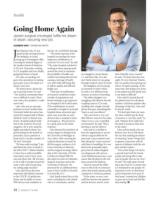
SHACHAR LAKS
Dr. Jake