

including diabetes and heart
problems, Robinson accepted
the position of vice president of
Chock Full o’
Nuts, a chain of
coffee shops in New York, after
the ’
56 season.
Toward the end of his
career, he wanted a bigger
home with more green land.
The Robinsons decided
on Stamford, Connecticut.
Redlining made it difficult to
find a home, but eventually
they found what they wanted.
They had to wait as the fin-
ishing touches were applied,
however. Their stressful story
was chronicled in a local paper
and read by Andrea Simon, the
wife of the co-founder of Simon
& Schuster. She suggested the
Robinsons move in with her
family until their place was
ready. Andrea’
s daughter, Carly,
a tomboy who wanted to play
outfield for the Dodgers, was
thrilled to have the Robinson
family. But Carly Simon opted
for the entertainment field
when she decided to strike out
on her own.
Jackie wasn’
t just a figurehead
in his new position. He worked
hard on bettering the company
and the relationship between
management and employees. He
also did what he could for civil
rights and took part in meetings
and marches. Robinson was at
the forefront when it came to
registering Black citizens to vote
and urging them to study the
candidates.
Robinson also found time
to appear at dinners for Jewish
causes. A frequent speaker
against antisemitism, Jackie was
especially harsh when antisemi-
tism infected the Black commu-
nity. In 1962, a Jewish business-
man wanted to open a steak-
house in Harlem. Angry Black
protesters didn’
t like the idea.
Robinson, who had a syndicat-
ed column in the New York Post
at the time, compared the Black
nationalists and their rhetoric to
that of Nazi Germany.
In his autobiography, he
said he was “ashamed to see
community leaders who were
afraid to speak out when Black
Americans were guilty of
anti-Semitism. How could we
stand against anti-Black preju-
dice if we are willing to practice
or condone a similar intoler-
ance?”
In 1964, Robinson helped
found the Freedom National
Bank in Harlem to help
Black citizens. Jack Roosevelt
Robinson was the bank’
s
first chairman of the board.
(Jackie’
s mother, who had been
the daughter of slaves, chose
his middle name to honor
Theodore Roosevelt, who died
25 days before her son was
born.)
In the 1960s, the Robinsons
held jazz concerts at their
Stamford home to raise
awareness and funds for the
Civil Rights movement. Ella
Fitzgerald, Dizzy Gillespie and
Sarah Vaughn were just a few of
the stars who performed on the
spacious lawn.
1972 was the 25th anniversa-
ry of Robinson breaking base-
ball’
s color barrier, and Jackie
was invited to throw out the
first pitch in the World Series
at Cincinnati. Nine days later,
on Oct. 24, 1972, Rachel was in
the kitchen preparing breakfast.
Jackie ran into the kitchen, put
his arms around her, said “I love
you,
” and slumped to the floor
dead of a heart attack. He was
only 53.
His life and career had a
lasting impact on baseball and
America, as did his stance
against antisemitism.
Author, columnist and public speaker
Irwin Cohen, who lectures on several
subjects, headed a national baseball
publication and interviewed many leg-
ends of the game before working for
the Detroit Tigers and earned a World
Series ring. He may be reached in his
dugout at irdav@sbcglobal.net.
AUGUST 27 • 2020 | 23
“They were very welcoming
to me and I made many friends
that lasted through the years.”
— JACKIE ROBINSON
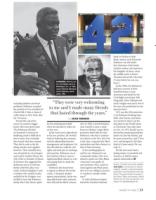
CLOCKWISE: With his son
at a Civil Rights march in
Washington, D.C., in 1963.
Jackie Robinson Memorial
Jackie Robinson, sports
caster, 1965
JTESLA16 VIA WIKIPEDIA
WIKIPEDIA
WIKIPEDIA