

WIKIMEDIA COMMONS
Jackie
Robinson
and the Jews
The celebrated baseball player
was a vocal opponent to antisemitism.
IRWIN COHEN CONTRIBUTING WRITER
Jews in the D
22 | AUGUST 27 • 2020
F
amed baseball player Jackie
Robinson was serving
in the army as a second
lieutenant, stationed at Fort
Riley, Kansas, and Fort Hood,
Texas. While he was there, prej-
udiced white officers wouldn’
t
give him a chance to try out for
the baseball team. After being
turned in to military police by a
bus driver for refusing to sit in
the rear seating area for Blacks
while on the base, Robinson
faced a court martial for disobe-
dience but eloquently won his
case.
After receiving an honorable
discharge, and with the doors
closed to Blacks in many fields,
including professional baseball,
Robinson joined the Kansas City
Monarchs of the Negro League
in 1945.
At that time, all major league
players were white. Fair-minded
men at the time had tried to
promote the integration of
Black people in baseball without
success. Boston’
s Jewish city
councilman Isidore Muchnick
threatened to pass legislation to
ban Sunday baseball in Boston
unless the Red Sox granted
a tryout to
three Negro
Leaguers. A
tryout was
arranged for
three players
from different
Negro League teams —Jackie
Robinson, Sam Jethroe and
Marvin Williams.
Robinson was the most
impressive of the trio, prompting
Red Sox manager Joe Cronin to
tell Muchnick that he hoped the
team would sign him. But Red
Sox owner Tom Yawkey never
showed interest. Unknown
to them, though, Brooklyn
Dodgers boss Branch Rickey
had been following Robinson’
s
activities on and off the field
much earlier. Rickey wanted to
break the color barrier but need-
ed the right man, not necessarily
the best player. He believed that
man was Jackie Robinson.
Rickey stunned baseball and
America by signing Jackie to a
professional baseball contract in
the off-season of
1945. Robinson
would start
in the minor
leagues and earn
his way to the big
leagues. Rickey
urged Robinson to marry his
love, Rachel Isum, who during
the war had worked as a rivet-
er in an aircraft factory while
graduating as a registered nurse.
Robinson took his advice.
In 1946, the Robinsons made
their home in Montreal as Jackie
starred for the top minor league
affiliate of the Dodgers. In 1947,
Robinson made it to the big
league.
As a Dodger, Robinson
received hundreds of threatening
letters in the mail warning him
not to take the field in several
cities. Jackie Robinson’
s major
league career lasted 10 seasons
and ended in 1956. His .311
career batting average, daring
on the basepaths and defensive
ability would guarantee him
enshrinement in the Baseball
Hall of Fame in Cooperstown,
New York.
Robinson often said how
lucky he was to play for the
Brooklyn Dodgers because
of the borough’
s large Jewish
population (more than a third
of Brooklyn’
s citizens in the
Robinson era were Jewish).
“They were very welcoming
to me and I made many friends
that lasted through the years,
”
Robinson said in a published
letter.
LIFE AFTER BASEBALL
At age 37 and with health issues,
AntiSemitism
the
Project
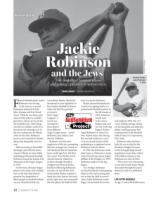
Brooklyn Dodger
Jackie Robinson
in 1954
WIKIPEDIA