

16 | AUGUST 27 • 2020
J
acob Ellenbogen has been planning to
take a gap year after high school since his
sophomore year, and when he found the
Kivunim International Gap Year Program,
he knew he wanted to do it. In a normal
year, students in the program learn about
the Jewish diaspora from a
home base in Israel, with trips
to different countries every few
weeks.
But then the COVID-19
pandemic struck.
“There was about a two-
week period where Europe was
doing worse than the United States” in terms
of controlling a coronavirus outbreak, said
Ellenbogen, who recently graduated from
Groves High School.
“I was a little, ‘
I’
m not so sure about this.
’
And then once the U.S. started doing signifi-
cantly worse than everyone else in the world
during this pandemic, if I can get out of this
country … then get me out of this country,
”
he told the Jewish News.
Ellenbogen is not the only recent high
school graduate from Metro Detroit who
decided to go forward with a gap year in
Israel as the COVID-19 pandemic continues.
And while programs will look different this
year — Kivunim has postponed all its travel
outside of Israel until the spring, with the
hopes that a vaccine will then be available —
they’
re still welcoming American students
with open arms.
Those differences will start as soon as stu-
dents walk off the plane — anyone coming
to Israel from another country currently has
to quarantine for 14 days upon arrival. Olivia
Feldman, a recent graduate of
Frankel Jewish Academy, will
participate in a gap year pro-
gram called Hevruta this year.
The program is bringing all
American participants to Israel
two weeks earlier than normal
so quarantine doesn’
t cut into
their regular programing time, Feldman said.
“When we get off the plane, they sepa-
rate us into six-people pods,
” Feldman said.
“Right from there, the people who run the
program pick you up, you go to your apart-
ment and you just don’
t leave for 14 days.
”
Micah Eizen, who just finished his senior
year at Farber Hebrew Day School, is also
headed to Israel this fall for a year of learning
at a yeshiva. His program will
quarantine for two weeks at
a hotel in Jerusalem. He said
there will be four to six students
per hotel room, and he isn’
t
sure if he’
ll be paired with the
roommate he’
ll live with for the
rest of the year.
The possibility of having to quarantine
with strangers is “a little nerve-wracking,
”
Eizen said. But “we all chose this yeshiva out
of all the other yeshivas that are going, [so]
we all have similar personality traits. It can be
a good thing.
”
While Feldman is excited to move to Israel
after being in Metro Detroit all summer, she
said she’
s starting to feel nervous about trav-
eling across the ocean during a pandemic.
She’
ll have to wear a mask for the entirety of
her 10-hour flight to Israel. Feldman is also
bringing her own kitchenware to the apart-
ments in which she’
ll quarantine and then
live for the rest of the school year.
“It’
s scary,
” she said. “I don’
t want to get
sick.
”
Leaving the country during a pandemic
also has gap-year participants worried about
what might happen to their relatives back
home. But Ellenbogen sees the positive side
of moving far away right now.
“I’
m worried something will happen to
my family, but even if I was going to school
[in America], there’
s still the chance that that
could happen. And that risk doesn’
t really
change. In fact, it’
s probably minimized a lit-
tle bit from the fact that I won’
t be interacting
with my family at all,
” he said.
While Ellenbogen also said he feels safer
being in a group of exclusively young peo-
ple, who are less likely to experience severe
symptoms from coronavirus, gap-year pro-
grams have to plan for the chance that par-
ticipants will get sick. Feldman said Hevruta
has set aside apartments for isolation units in
case anyone catches the virus after the initial
14-day quarantine.
“It’
s the only thing you can really do,
” she
said. And “if it was a real health concern,
unfortunately, they would have to be sent
home. But hopefully it doesn’
t come to that.
”
Despite the stressors of moving halfway
across the globe right now, Feldman said
she’
s confident she’
ll have a great year in
Israel.
“It’
s such a unique experience because I’
m
not going to college right away, and sure, I’
m
nervous, but I’
m just really excited to get a
little change of scenery and just a really won-
derful year ahead,
” she said.
As Eizen put it, “It feels crazy. And it
would have been crazy even without a pan-
demic.
”
Jews in the D
Gap Years
Press On,
Despite
Pandemic
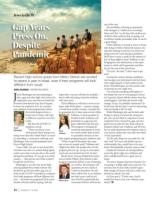
Recent high school grads from Metro Detroit are excited
to spend a year in Israel, even if their programs will look
different from usual.
MAYA GOLDMAN CONTRIBUTING WRITER
Jacob
Ellenbogen
Micah Eizen
Olivia
Feldman
PIXABAY