

AUGUST 6 • 2020 | 9
F
ifteen years ago, my
family spent a leisurely
Sunday at the Henry Ford
Museum in Dearborn, perus-
ing the incredible Americana
available to enjoy
and experience.
As we took the
time to sit in the
Rosa Parks bus,
which sits in
the museum on
permanent dis-
play, I noticed an
African American family sitting
near us. I turned to my wife
and quipped, “If Henry Ford
knew that a Jewish family was
sitting together with an African
American family in the Rosa
Parks bus in the museum that
carried his name, he would be
rolling in his grave.
”
My wife responded with a
bitter smirk as she recognized
the accuracy of my painful joke.
But in truth, it was and is pain-
ful, and it was not funny. Rather
than try and sweep Henry Ford’
s
virulent racism and antisemi-
tism under the rug, it is time to
confront that history head-on.
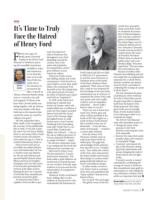
Henry Ford wasn’
t just an
incredibly successful entrepre-
neur and industrialist. He was
a virulent racist and antisem-
ite. He not only believed and
spewed hateful rhetoric about
Blacks and Jews; he bought a
newspaper and over the course
of several years promoted the
Protocols of the Elders of Zion,
blaming the Jews for a myriad
of evils that they ostensibly per-
petrated around the globe.
As historian Hasia Diner
explains, Ford was able to pro-
mote his hatred not
only in Dearborn, but
throughout every Ford
dealership around the
country. Due to his
status and popularity,
his antisemitism carried
great influence across
American culture.
Moreover, Ford’
s venom
had chilling, deadly real-world
consequences. Ford served as a
role model to no less than Adolf
Hitler, who mentioned Ford
favorably in his Mein Kampf, kept
a life-sized portrait of Ford in
his office in Munich and consid-
ered Ford an “inspiration.
”
In 1938, as the Nazis were
preparing to unleash their
armies on Europe, which ulti-
mately killed tens of millions of
souls, the Nazi regime awarded
Henry Ford with the Grand
Cross of the German Eagle,
the highest honor it could
bestow upon a non-German.
Testifying at the Nuremberg
trials after World War II, con-
victed Hitler Youth leader
Baldur von Schirach — who, in
his role as military governor of
Vienna, deported 65,000 Jews
to camps in Poland — stated:
“The decisive antisemitic book
I was reading and the book that
influenced my comrades was
... that book by Henry Ford,
The International Jew. I read it
and became antisemitic. The
book made a great influence on
myself and my friends because
we saw in Henry Ford the repre-
sentative of success and also the
representative of a progressive
social policy.
”
Moreover, Ford’
s vocal hatred
had a chilling effect on the
millions of American Jews who
undoubtedly felt threatened by
Ford’
s hatred and did very little
to lobby the U.S. government
to stop the mass extinction of
European Jewry at the hands
of the Nazis. Professor Diner
explained, “Their sense of what
they could do was tempered by
the knowledge of how pervasive
antisemitism was in America. If
somebody like Henry Ford, with
such power and such wealth,
could be such an outspoken
antisemite … there’
s really a
limit to what we can do.
”
There’
s no way to know how
many Jews, Roma, gays and
other civilians perished at the
hands of the Nazi regime as a
result of Henry Ford’
s hatred.
But a number in the tens of
thousands — if not the hun-
dreds of thousands — would be
a conservative estimate.
Even the Henry Ford
Museum’
s website seems to
equivocate about Ford’
s tar-
nished past. The page that
acknowledges Ford’
s antisemi-
tism describes it as a “complex”
story:
“Seen within the context
of the times, they demonstrate
the sharp realities and tensions
that emerge in societies under-
going profound cultural, eco-
nomic and political change.
”
In other words, we have to
view Henry Ford as a product
of his time and understand the
“sharp realities” that led to his
hatred of Jews.
No, we don’
t. Not any longer.
The global events of the last
month have prompted
many around the world
to reevaluate the venera-
tion of historical figures
who may have achieved
great accomplishments,
but whose legacy was tar-
nished by hatred and rac-
ism. Princeton University
recently announced that it
would remove the name
of President Woodrow
Wilson from its school of
public policy and a resi-
dential college. Princeton
stated that, “We have taken
this extraordinary step
because we believe that
Wilson’
s racist thinking and pol-
icies make him an inappropriate
namesake for a school whose
scholars, students and alumni
must be firmly committed to
combating the scourge of racism
in all its forms.
”
I do not minimize the great
contributions of the Ford fam-
ily to the United States and its
decades-long effort to distance
itself from the hatred of the
family patriarch. But today,
good works are not enough.
Henry Ford’
s virulent hatred
is too damning to allow us to
overlook any longer.
The Henry Ford Museum
must take immediate action to:
• Change the name of the
museum to the Ford
Museum, removing the name
of its namesake.
• Remove the statue that stands
proudly today at the entrance
to Greenfield Village.
• Construct a permanent dis-
play at the museum catalog-
ing Ford’
s antisemitism and
racism, bringing the truth of
Ford’
s history into the light
of day.
If modern society is indeed
committed to combatting the
scourge of racism in all forms,
that commitment must apply to
antisemitism as well. Telling the
true, full history of Henry Ford
will be an important first step.
Reuven Spolter served as the rabbi of
Young Israel of Oak Park until 2008.
essay
It’s Time to Truly
Face the Hatred
of Henry Ford
Reuven
Spolter