

Arts&Life
review
G
unther Stern, born in
Hildesheim, Germany, in
1922, now lives in West
Bloomfield, and works at the Holocaust
Memorial Center. Highlights of his
activities between then and now pro-
vide the material for his new memoir,
Invisible Ink, published by Wayne State
University Press.
Not long after the Nazis came to
power in Germany in January 1933,
Julius and Hedwig Stern had the fore-
sight to try to get their oldest son,
Gunther, official permission to emigrate
to St. Louis. Once there, at the home of
his aunt and uncle, he was expected to
work to bring to the rest of the family
— his parents and his younger brother
and sister.
Julius warned his son to keep a low
profile, to make himself unnoticeable
“like invisible ink,
” until the family could
meet again. In 1937, Gunther faced a
most fearsome hurdle: getting approval
from the American Counsel General
in Hamburg, Malcom Burke. Most
American officials systematically denied
approvals; Burke promptly stamped the
forms, and Gunther went to America.
In St. Louis, he found a supportive
home, an excellent high school and
a way to make a living: working in
restaurants, first as a busboy and then
as a waiter. Also a new first name: A
girlfriend called him “Guy,
” a name that
Americans could pronounce.
To rescue his family, the waiter
recruited a wealthy restaurant patron to
sponsor their immigration. The com-
munity’
s immigration lawyer, however,
explained that the patron’
s profession,
“gambler”
, technically disqualified him
as a sponsor. The lawyer would not even
try to circumvent the law. The family
remained in Germany to be murdered.
When the war began, the U.S. Army
recruited Guy and other young immi-
grants who knew the language and
culture of enemy countries. They were
known as the Ritchie Boys. The Army
offered citizenship to the stateless young
soldier, now officially Guy Stern. In
France, right after the D-Day invasion,
Stern interrogated German prisoners of
war about the remaining German forces.
After the war, Stern earned graduate
degrees in German studies, rekindling
his love of the language that had also
rejected him. He loved the writers of the
Enlightenment, such as Lessing, who
32 | AUGUST 6 • 2020
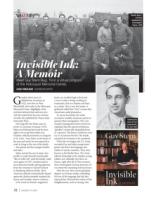
Invisible Ink:
A Memoir
Meet Guy Stern Aug. 19 in a virtual program
of the Holocaust Memorial Center.
LOUIS FINKELMAN CONTRIBUTING WRITER
Entering the
Army at Fort
Leavenworth,
KS, Fall 1942
“Ritchie Boys”:
1st Army
Headquarters
Interrogation
Teams, 1944
PHOTOS COURTESY OF GUY STERN